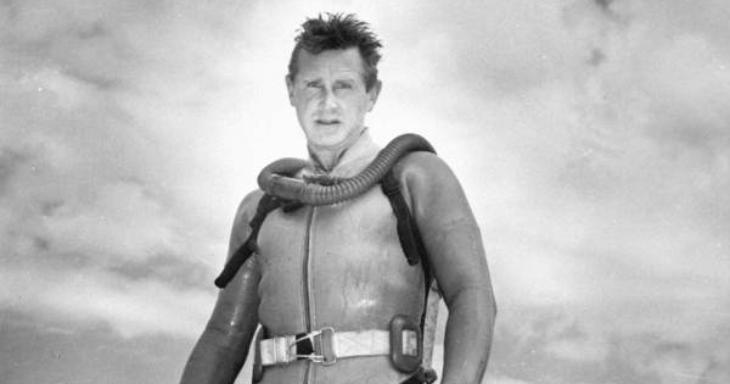
The correct answer is Sea Hunt. The series followed diver Mike Nelson, played by Lloyd Bridges, and became one of television’s best-known underwater adventure shows from the late 1950s and early 1960s.
Sea Hunt is the 1960s series that followed diver Mike Nelson, played by Lloyd Bridges. The show actually began in 1958 and continued into the early 1960s, becoming one of the best-known underwater adventure programs of its era. Its lead character, Mike Nelson, was a former Navy frogman who worked as a freelance scuba diver. Each episode placed him in a different underwater problem, often involving rescues, investigations, sunken wrecks, dangerous equipment, or people trapped below the surface.
Lloyd Bridges gave the series much of its authority. Before Sea Hunt, he had already appeared in many films and television roles, but this show made him closely associated with scuba diving in the public imagination. As Mike Nelson, he brought a calm, confident style to the role. The character rarely seemed rattled, even when dealing with sharks, criminals, cave dives, lost treasure, or sabotage. That steady presence helped sell the idea that Nelson was an expert who knew how to handle serious risks underwater.
Sea Hunt arrived at a time when scuba diving was becoming more familiar to the American public. Jacques Cousteau’s work, postwar advances in diving equipment, and growing interest in ocean exploration all helped make underwater adventure feel modern and exciting. Television viewers in the late 1950s and early 1960s were seeing a world that still felt mysterious. Underwater photography was not as common then as it is now, so scenes of divers moving through reefs, shipwrecks, kelp beds, and murky depths had a strong novelty value.
The show was also unusual because it relied so heavily on underwater filming. Many television adventures of the period were built around western towns, police offices, living rooms, or city streets. Sea Hunt gave viewers something different. A large part of its identity came from the diving sequences, the air tanks, the masks, the fins, and the silent tension of being beneath the surface. Action scenes could involve a stuck valve, a cut air hose, a lost diver, or a race to reach the surface in time. The risks were easy to understand even for viewers who knew nothing about diving.
Mike Nelson often narrated the episodes, which gave the show a documentary-like feel. His voice explained what was happening underwater and helped viewers follow the action when dialogue was impossible. That narration became one of the show’s signatures. It made the underwater scenes feel technical but still accessible, giving audiences enough information to understand the danger without slowing down the story.
Sea Hunt was produced in black and white, and that added to its serious tone. The underwater footage often looked shadowy and dramatic, especially by the standards of television at the time. The show’s stories were usually straightforward, but the setting made them stand out. A rescue at sea, a search for evidence, or a confrontation with a criminal had a different feeling when it unfolded below the waterline.
The series was also influential because it helped popularize scuba diving. Many viewers first became interested in the sport after watching Lloyd Bridges as Mike Nelson. Diving equipment, underwater safety, and ocean exploration were not just background props in the show. They were central to its appeal. Sea Hunt made scuba diving look adventurous, skilled, and heroic, while still showing that it required discipline and caution.
The other answer choices point in similar adventure directions, but they do not match the clue. Flipper centered on a friendly dolphin and a Florida family. Voyage to the Bottom of the Sea was a science-fiction adventure about a futuristic submarine. The Aquanauts also involved underwater work, but Mike Nelson was specifically the main character of Sea Hunt. Lloyd Bridges’ role as Nelson remains one of the most recognizable diving characters in classic television.
Start a 10-question trivia challenge and see how many familiar shows, stars, and classic trivia facts you remember.
Start the Challenge