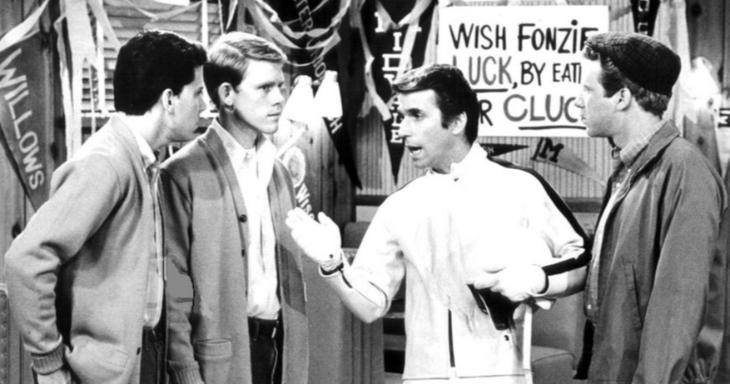
Classic TV Trivia Question
A nostalgic sitcom question about Happy Days, Arnold’s Drive-In, Fonzie, and the gang’s favorite hangout.
Classic TV Trivia Question
Question

What was the name of the diner where Fonzie and his friends hung out in Happy Days?

Correct Answer
Arnold's Drive-In

The correct answer is Arnold’s Drive-In. On Happy Days, Arnold’s was the diner where Fonzie, Richie Cunningham, and the gang often hung out.

Like classic TV trivia?
Start a 10-question trivia challenge beginning with a question like this. No signup needed to begin.
Start the Challenge
Why Arnold’s Drive-In Is the Correct Answer

Arnold’s Drive-In was the diner where Fonzie and the gang hung out in Happy Days. The familiar restaurant became one of the most recognizable settings on the show, serving as the gang’s hangout for Richie Cunningham, Arthur “Fonzie” Fonzarelli, Potsie Weber, Ralph Malph, Joanie Cunningham, and many of the other characters who moved through the world of the series. For viewers, Arnold’s Drive-In helped define the show’s warm, colorful version of 1950s nostalgia.

Happy Days premiered on ABC in 1974 and became one of the most popular American sitcoms of the decade. Although the show aired during the 1970s and 1980s, it was set mainly in the 1950s and early 1960s in Milwaukee, Wisconsin. That setting gave the series its jukeboxes, leather jackets, drive-ins, school dances, soda-shop dates, rock and roll references, and family-centered stories. Arnold’s Drive-In fit perfectly into that world.

The Happy Days diner name is strongly tied to the show because Arnold’s was more than a place to eat. It was the social center for the younger characters. Richie, Potsie, Ralph, Fonzie, and their friends met there after school, planned dates, talked through problems, listened to music, and spent time away from home and school. The restaurant gave the series a natural gathering place where different storylines could begin, collide, or resolve.

Arnold’s Drive-In had the look and feeling of a classic mid-century teen hangout. It featured booths, a counter, a jukebox, neon-style atmosphere, and the kind of casual restaurant setting associated with the 1950s. Characters could order burgers, fries, milkshakes, or sodas while talking about school, romance, cars, dances, and whatever trouble had just come up. The setting made the show feel rooted in an idealized version of teenage life from that era.

The restaurant was originally run by Arnold Takahashi, played by Pat Morita, who later became widely known for The Karate Kid. Arnold was a warm and funny presence in the series, often reacting to the younger characters’ schemes and conversations from behind the counter. His character gave the diner its name and added to the show’s mix of family comedy, friendship, and lighthearted conflict.

Later in the series, Al Delvecchio, played by Al Molinaro, became the owner of Arnold’s. The restaurant kept its name, even though Al became the more familiar operator for many viewers. Al’s friendly personality, slightly worried manner, and regular involvement with the gang made him another important part of the diner’s identity. The change in ownership did not weaken the setting. Arnold’s remained the central hangout and one of the show’s most important locations.

Fonzie’s connection to Arnold’s helped make the diner even more famous. Fonzie often appeared there in his leather jacket, offering advice, fixing problems, or making an entrance that immediately drew attention. He was originally introduced as a supporting character, but Henry Winkler’s performance turned Fonzie into the breakout star of Happy Days. Arnold’s gave Fonzie a place to interact with Richie and the others outside the Cunningham home, which helped the character become part of the group rather than just a neighborhood tough guy.

The diner also helped balance the show’s two main worlds. The Cunningham house represented family, parents, values, and home life. Arnold’s represented friends, music, dating, independence, and teenage identity. Moving between those two settings allowed Happy Days to tell stories about growing up while still keeping the tone friendly and accessible. Richie could have a problem at Arnold’s, bring it home to Howard and Marion Cunningham, then return to the diner with a lesson learned or a new plan.

Arnold’s Drive-In also became important visually. A sitcom benefits from a place viewers instantly recognize, and Arnold’s had that quality. The moment the characters walked through the door or gathered around a booth, the audience knew what kind of scene to expect. It could be a joke-heavy group conversation, a romantic misunderstanding, a school-related crisis, or one of Fonzie’s cool entrances. The set gave Happy Days a rhythm and familiarity that helped make it feel comfortable week after week.

The nostalgia around Arnold’s has lasted because the diner represents a style of American pop culture that many people associate with the 1950s: drive-ins, jukebox music, burgers, shakes, cars, letterman sweaters, and the early rock and roll era. Happy Days did not present the 1950s as a strict documentary version of history. It created a polished, affectionate TV version of the period, and Arnold’s Drive-In was one of the clearest symbols of that tone.

The answer is Arnold’s Drive-In. On Happy Days, Arnold’s was the classic TV diner where Fonzie, Richie Cunningham, and the rest of the gang met, talked, dated, danced, and spent time together in the show’s nostalgic Milwaukee setting.

More Classic TV Trivia Questions

Ready for another challenge?

Start a 10-question trivia challenge and see how many classic shows, actors, characters, catchphrases, and TV moments you know.

Start the Challenge
Browse more: Classic TV Trivia