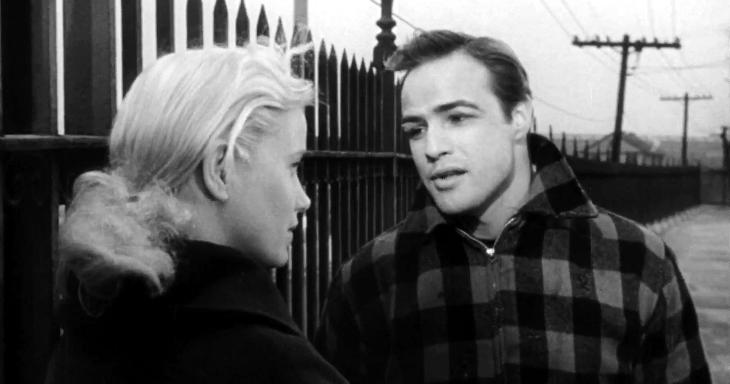

Which iconic actor won an Academy Award for his role as Terry Malloy in the 1954 crime drama "On the Waterfront"?
The correct answer is Marlon Brando. He won Best Actor for playing Terry Malloy in On the Waterfront.
Marlon Brando is the answer. In On the Waterfront, the 1954 Columbia Pictures crime drama directed by Elia Kazan and written by Budd Schulberg, Brando played Terry Malloy, a former boxer and dockworker caught inside a waterfront corruption story alongside Eva Marie Saint, Karl Malden, Rod Steiger, and Lee J. Cobb.
Marlon Brando as Terry Malloy
Terry Malloy is a dockworker whose past as a boxer still shapes how others see him and how he sees himself. Brando’s performance centers on a man pressured by loyalty, fear, guilt, and the corrupt system controlling the waterfront. His Best Actor win came from a role that required both physical toughness and emotional vulnerability.
Kazan, Schulberg, and the Waterfront Story
On the Waterfront was directed by Elia Kazan and written by Budd Schulberg. The film’s story focuses on dockworkers, union corruption, intimidation, and the personal cost of speaking out. Eva Marie Saint played Edie Doyle, Karl Malden played Father Barry, Lee J. Cobb played Johnny Friendly, and Rod Steiger played Terry’s brother Charley.
The Taxi-Cab Scene and Brando’s Acting Style
One of Brando’s best-known moments in the film comes in the taxi-cab scene with Rod Steiger. The scene reveals Terry’s regret over his boxing career and his complicated relationship with his brother. Brando’s quiet delivery, pauses, and naturalistic reactions helped make the scene a key example of his screen acting style without needing a large action moment.
Academy Awards and Film Recognition
Brando won the Academy Award for Best Actor for playing Terry Malloy. On the Waterfront also won Best Picture, confirming its major place among 1950s American crime dramas. Its recognition is tied directly to Kazan’s direction, Schulberg’s screenplay, Brando’s central performance, and the film’s focused portrait of waterfront corruption.
Ready for another challenge?
Start a 10-question challenge and test your knowledge of classic films, actors, directors, movie quotes, and Hollywood history.
Start the Challenge