Classic Music Trivia Question
A classic music question about Roy Orbison and his unforgettable hit songs.
Classic Music Trivia Question
Question

"Oh, Pretty Woman,", "Only the Lonely," and "Crying" are three hit songs recorded by which Texas-born American singer-songwriter?

Correct Answer
Roy Orbison

The correct answer is Roy Orbison. The Texas-born singer-songwriter recorded “Oh, Pretty Woman,” “Only the Lonely,” and “Crying,” three of his most recognizable songs.

Like classic music trivia?
Start a 10-question trivia challenge beginning with a question like this. No signup needed to begin.
Start the Challenge
Why Roy Orbison Is the Correct Answer

Roy Orbison was the Texas-born American singer-songwriter who recorded “Oh, Pretty Woman,” “Only the Lonely,” and “Crying.” He was born on April 23, 1936, in Vernon, Texas, and became one of the most recognizable voices in American popular music. Orbison’s sound stood apart from many of his contemporaries. While early rock and roll often emphasized swagger, youth, and rhythm, Orbison brought a more dramatic and emotional style. His songs often dealt with loneliness, longing, heartbreak, and romantic vulnerability, carried by a voice that could move from a deep, controlled tone to a soaring high range.

Orbison grew up in Texas and started playing music young. His family moved around the state, and he was exposed to country music, gospel, pop, and early rock and roll. Like many artists of his generation, he first gained wider attention through the orbit of Sun Records in Memphis, the label linked to Elvis Presley, Johnny Cash, Jerry Lee Lewis, and Carl Perkins. Orbison recorded “Ooby Dooby” in the 1950s, which gave him an early hit, but his most enduring style developed later when he moved toward bigger, more dramatic ballads.

“Only the Lonely” became one of Roy Orbison’s breakthrough recordings in 1960. The song helped establish the haunting, operatic quality that made him different. Instead of sounding like a typical rock and roll frontman, Orbison sounded almost cinematic. His voice had a sense of stillness and control, then rose into powerful emotional peaks. The song’s arrangement was sparse enough to let the vocal carry the weight, and that became a hallmark of his best work.

“Crying,” released in 1961, pushed that style even further. It was a song about heartbreak, but Orbison’s performance made it feel unusually intense without becoming messy or uncontrolled. He did not simply sing about sadness. He built the emotion carefully, letting the melody climb until the final lines felt overwhelming. “Crying” showed why Orbison was often described as having an almost operatic voice. He used range and dynamics in a way that few rock or pop singers of the period could match.

“Oh, Pretty Woman,” released in 1964, gave Orbison one of his biggest and most instantly recognizable hits. Its famous guitar riff, confident rhythm, and playful spoken-sung phrases made it different from his darker ballads. The song had a brighter, more upbeat feel, but it still carried his unmistakable voice. It became a major international success and later found new life through its association with the 1990 film Pretty Woman. Even people who do not know much about Orbison often recognize the opening riff and title phrase.

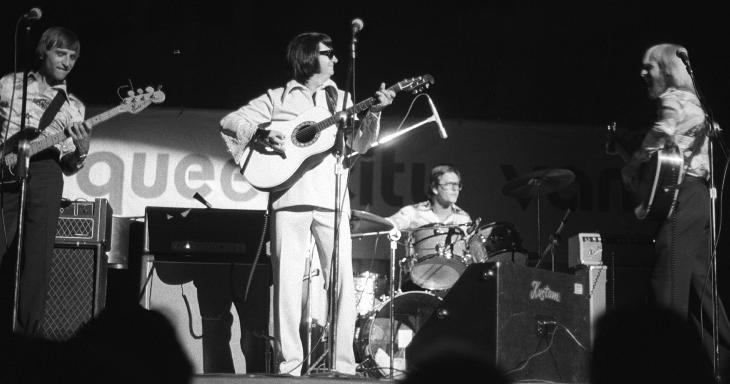
Orbison’s appearance also became part of his image. He was known for wearing dark clothing and dark glasses, a look that made him seem mysterious and reserved. The glasses were partly practical, but they became inseparable from his public identity. Unlike many pop stars of the 1960s, he did not rely on dancing or flashy stage movement. He often stood almost still at the microphone, letting the songs and his voice create the drama.

His career included both great success and deep personal tragedy. In the 1960s, his wife Claudette died in a motorcycle accident, and two of his sons later died in a house fire. Those losses added to the public sense of Orbison as an artist connected to sorrow, though his music had already explored those feelings before tragedy struck his life so directly.

Orbison experienced a major revival in the 1980s. Younger musicians praised his influence, and he became part of the Traveling Wilburys with George Harrison, Bob Dylan, Tom Petty, and Jeff Lynne. His late-career comeback included the album Mystery Girl, released shortly after his death in 1988. The hit “You Got It” introduced him to another generation of listeners.

Roy Orbison’s legacy rests on a voice that was immediately identifiable and a catalog of songs that blended rock and roll, country, pop, and dramatic balladry. “Oh, Pretty Woman,” “Only the Lonely,” and “Crying” show different sides of his talent: the commanding hitmaker, the lonely balladeer, and the singer who could turn heartbreak into something almost grand.

More Classic Music Trivia Questions

Ready for another challenge?

Start a 10-question trivia challenge and see how many familiar songs, singers, and music facts you know.

Start the Challenge
Browse more: Classic Music Trivia