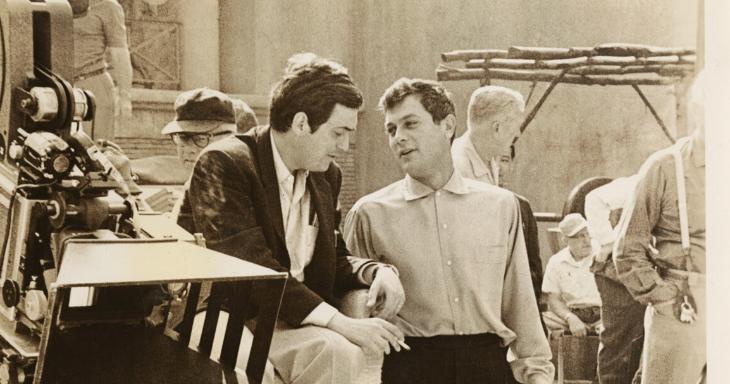
Classic Movie Trivia Question
A classic movie question about Spartacus, Kirk Douglas, and Stanley Kubrick.
Classic Movies Trivia Question
Question

Who directed the hit 1960 film "Spartacus" starring Kirk Douglas?

Correct Answer
Stanley Kubrick

The correct answer is Stanley Kubrick. He directed the 1960 historical epic Spartacus, which starred Kirk Douglas as the gladiator who leads a slave revolt against Rome.

Like classic movie trivia?
Start a 10-question trivia challenge beginning with a question like this. No signup needed to begin.
Start the Challenge
Why Stanley Kubrick Is the Correct Answer

Stanley Kubrick directed the hit 1960 film Spartacus, starring Kirk Douglas. The movie became one of the major historical epics of its era, combining large-scale action, Roman political drama, and a story built around rebellion, slavery, loyalty, and freedom. Although it is often remembered as a Kirk Douglas film, especially because Douglas both starred in it and helped bring it to the screen, Kubrick was the director who completed the picture and gave it much of its visual discipline.

The film tells the story of Spartacus, a Thracian slave who is trained as a gladiator and eventually leads a massive slave revolt against the Roman Republic. Kirk Douglas plays Spartacus as a man of strength and conviction, but also as someone shaped by suffering and injustice. The character is not simply a warrior. He becomes a symbol of resistance to a brutal system. The film follows his rise from captivity to leadership, while also showing the political response from Rome’s powerful elites.

Spartacus was based on the 1951 novel by Howard Fast, who had written the book after being blacklisted during the Red Scare period. The screenplay was written by Dalton Trumbo, another blacklisted writer. Kirk Douglas made an important decision by giving Trumbo screen credit under his real name. That mattered because Hollywood’s blacklist had kept many writers from receiving public credit for their work. Spartacus did not end the blacklist by itself, but it became one of the films most closely associated with breaking its hold on the industry.

Stanley Kubrick was not the first director attached to the production. Anthony Mann began directing the film, but he was dismissed early in filming. Kirk Douglas then brought in Kubrick, with whom he had worked on Paths of Glory in 1957. Kubrick was still a young director at the time, but he already had a reputation for precision and seriousness. Spartacus gave him his first opportunity to direct a large Hollywood epic with a major budget, a large cast, and huge battle scenes.

The cast was unusually strong. Along with Kirk Douglas, the film featured Laurence Olivier as Roman general and politician Marcus Licinius Crassus, Jean Simmons as Varinia, Charles Laughton as Gracchus, Peter Ustinov as Batiatus, and Tony Curtis as Antoninus. Ustinov won the Academy Award for Best Supporting Actor for his performance. The actors gave the film a range of tones, from Douglas’s heroic intensity to Ustinov’s sly comic intelligence and Olivier’s cold aristocratic authority.

One of the film’s most famous moments is the “I’m Spartacus” scene. After the slave army is defeated, Roman forces demand that Spartacus identify himself. Instead, one man after another rises and declares, “I’m Spartacus.” The scene became one of the best-known expressions of solidarity in American movies. It works because it turns defeat into moral defiance. The rebels may have lost militarily, but they refuse to surrender their leader or their shared identity.

The film’s scale was also a major part of its impact. Spartacus includes large battle formations, Roman military spectacle, gladiator training sequences, lavish interiors, and crowd scenes that matched the epic style popular in Hollywood at the time. The late 1950s and early 1960s were filled with grand historical productions, including films set in ancient Rome, biblical lands, and other sweeping historical settings. Spartacus fit that trend, but it also had a sharper political edge than many similar epics.

Kubrick later had complicated feelings about the film because he did not have the full creative control he wanted. As his career developed, he became known for exerting unusually strong control over his projects. Spartacus was different. Kirk Douglas, the studio, and the production structure all shaped the final result. Still, the film remains an important part of Kubrick’s career because it showed he could handle a large production and work with major stars. After Spartacus, he moved toward films where his personal style and control were much stronger, including Lolita, Dr. Strangelove, 2001: A Space Odyssey, A Clockwork Orange, and The Shining.

Spartacus won four Academy Awards and became one of the most memorable historical dramas of its time. Its answer is Stanley Kubrick, but the film’s legacy also belongs to Kirk Douglas, Dalton Trumbo, and the broader Hollywood moment in which it was made.

More Classic Movie Trivia Questions

Ready for another challenge?

Start a 10-question trivia challenge and see how many famous films, stars, and movie moments you know.

Start the Challenge
Browse more: Classic Movies Trivia