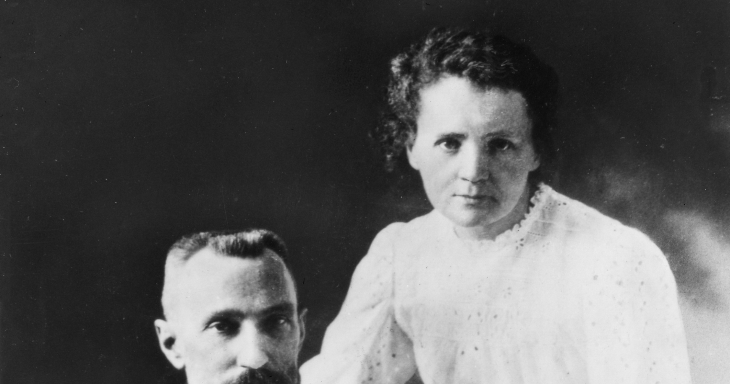
Famous People Trivia Question
A science history question about Marie Curie, radioactivity, and her Nobel Prize achievements.
Famous People Trivia Question
Question

Who was the first female to win the Nobel Prize?

Correct Answer
Marie Curie

The correct answer is Marie Curie. She became the first woman to win a Nobel Prize when she shared the 1903 Nobel Prize in Physics for work connected to radioactivity.

Like famous people trivia?
Start a 10-question trivia challenge beginning with a question like this. No signup needed to begin.
Start the Challenge
Why Marie Curie Is the Correct Answer

Marie Curie was the first female to win the Nobel Prize and the first woman to win a Nobel Prize. She received the Nobel Prize in Physics in 1903 for work connected to radioactivity, sharing the award with her husband Pierre Curie and the French physicist Henri Becquerel. Her achievement made her one of the most important figures in scientific history, and her later Nobel Prize in Chemistry in 1911 made her the only person to win Nobel Prizes in two different scientific fields.

Marie Curie was born Maria Skłodowska in Warsaw, Poland, in 1867, when Poland was under Russian control. She grew up in a family that valued education, but opportunities for women were limited. Because women could not easily pursue advanced university study in her homeland, she eventually moved to Paris, where she studied at the Sorbonne. There she became known for her discipline, intelligence, and ability to work under difficult conditions.

In Paris, she met Pierre Curie, a physicist whose research interests matched her own. Their scientific partnership became one of the most famous in modern science. Marie Curie chose to study unusual rays emitted by uranium compounds, building on the work of Henri Becquerel. Becquerel had discovered that uranium salts gave off penetrating rays without needing sunlight or an outside source of energy. Curie studied this phenomenon in detail and helped develop the concept of radioactivity.

The word radioactivity became closely tied to Curie’s research. She found that the strength of the rays depended on the amount of uranium present, not on the chemical form of the substance. That suggested the energy was coming from inside the atom itself, a major idea at a time when atoms were often thought of as indivisible and stable. Her work helped open the door to modern atomic physics.

Marie and Pierre Curie also studied pitchblende, a uranium-rich mineral. Curie noticed that pitchblende was more radioactive than could be explained by its uranium content alone. This led her to believe that it contained unknown radioactive elements. After long and physically demanding work, the Curies identified two new elements: polonium, named for Marie’s native Poland, and radium, named for its intense radioactivity.

The 1903 Nobel Prize in Physics recognized the importance of this research. Henri Becquerel was honored for his discovery of spontaneous radioactivity, while Marie and Pierre Curie were honored for their joint investigations into radiation phenomena. Marie Curie’s inclusion was historic. She became the first woman to receive a Nobel Prize, breaking through a barrier in a scientific world dominated by men.

Her work did not stop there. After Pierre Curie died in a street accident in 1906, Marie Curie continued her research and took over his professorship at the Sorbonne, becoming the first woman to teach there. She isolated radium in a purer form and continued studying radioactive substances with remarkable persistence. In 1911, she won the Nobel Prize in Chemistry for her discoveries of radium and polonium and for her work on isolating radium and studying its properties.

That second Nobel Prize made Curie’s place in history even more extraordinary. She remains the only person to win Nobel Prizes in two different scientific fields: Physics and Chemistry. Other people have won two Nobel Prizes, but Curie’s combination of awards across separate sciences is unique. Her achievements helped shape physics, chemistry, medicine, and the study of atomic structure.

Curie’s research also had practical effects. Radioactive materials later became important in medical imaging and cancer treatment, though the dangers of radiation exposure were not fully understood during her lifetime. Curie often worked with radioactive substances without the safety protections used today. Her notebooks and laboratory papers remain radioactive and are still handled with special care.

During World War I, Curie helped develop mobile X-ray units that could be used near battlefields. These units, sometimes called “Little Curies,” allowed doctors to locate bullets and shrapnel in wounded soldiers. Her daughter Irène helped with this wartime medical work and later became a Nobel Prize-winning scientist herself.

The answer is Marie Curie. She was the first female to win the Nobel Prize, sharing the 1903 Nobel Prize in Physics with Pierre Curie and Henri Becquerel for work connected to radioactivity, then winning the 1911 Nobel Prize in Chemistry for her discoveries and research involving radioactive elements.

More Famous People Trivia Questions

Ready for another challenge?

Start a 10-question trivia challenge and see how many actors, singers, inventors, presidents, authors, athletes, and historical figures you know.

Start the Challenge
Browse more: Famous People Trivia