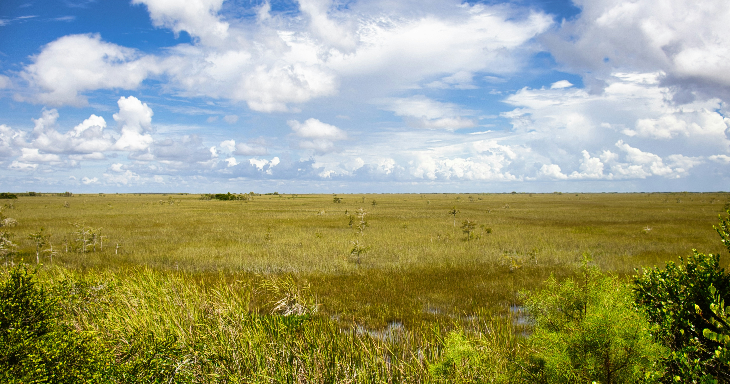
The correct answer is Florida. Everglades National Park is located in southern Florida and protects one of the most important wetland ecosystems in the United States.
Florida is the U.S. state where you would find Everglades National Park, one of the most unusual and important natural areas in the United States. Located in southern Florida, the park protects a vast wetland landscape made up of sawgrass marshes, mangrove forests, hardwood hammocks, pine rocklands, coastal waters, and slow-moving freshwater systems. It is often described as a “river of grass,” a phrase made famous by conservationist Marjory Stoneman Douglas, because much of the Everglades is not a deep swamp but a broad, shallow sheet of water moving slowly across the land.
Everglades National Park was established in 1947 and is the largest subtropical wilderness in the United States. Unlike some national parks that were created mainly for dramatic mountains, canyons, or waterfalls, the Everglades was protected because of its living ecosystem. Its value comes from water, wildlife, plants, and the delicate connections between them. The park preserves part of a much larger Everglades region that once covered a huge section of southern Florida before canals, roads, farms, and development changed the natural flow of water.
Water is the key to understanding the Everglades. Historically, rainwater flowed from central Florida into Lake Okeechobee, then slowly moved south through marshes toward Florida Bay. This sheet flow supported plants and animals adapted to seasonal wet and dry periods. When water levels rise and fall naturally, fish, birds, alligators, and plants respond. When the water is blocked, drained, polluted, or redirected, the whole ecosystem changes. That is why Everglades restoration has been such a major environmental issue in Florida for decades.
The park is famous for its wildlife. It is one of the few places in the world where alligators and crocodiles live in the same general area. American alligators are common in freshwater marshes and canals, while American crocodiles are usually found closer to brackish and saltwater areas near the coast. The Everglades is also home to manatees, turtles, snakes, frogs, deer, river otters, and many fish species. The endangered Florida panther lives in the broader South Florida region, though sightings are rare.
Birdlife is one of the park’s great attractions. Wading birds such as herons, egrets, ibises, spoonbills, and wood storks depend on the wetlands for feeding and nesting. In the past, plume hunting caused major declines in some bird populations because feathers were used in fashion. Conservation efforts helped protect these species, and the Everglades became a symbol of the need to preserve bird habitat. During the dry season, when water levels drop and fish become concentrated in smaller pools, bird activity can be especially visible.
The Everglades also contains mangrove forests along the coast. Mangroves help protect shorelines, provide nursery habitat for fish, and support marine life in Florida Bay and the Gulf region. Inland, sawgrass marshes stretch across open wetland areas, while tree islands and hardwood hammocks provide slightly higher ground where different plants and animals can survive. This mix of habitats gives the park a remarkable variety despite its generally flat landscape.
The park has faced serious threats. Drainage projects in the 20th century reduced the natural flow of water through the Everglades. Agricultural runoff, urban growth, invasive species, and climate change have added more pressure. Burmese pythons, an invasive species now established in South Florida, have caused major concern because they prey on native wildlife. Rising sea levels also threaten coastal parts of the park by pushing saltwater farther inland.
Even with those challenges, Everglades National Park remains one of Florida’s defining natural landmarks. Visitors can explore it by walking boardwalk trails, paddling through mangrove tunnels, taking ranger-led programs, driving scenic roads, or watching wildlife from observation areas. Popular access points include Shark Valley, the Ernest F. Coe Visitor Center area near Homestead, and the Gulf Coast side near Everglades City.
The correct answer is Florida, the state most closely associated with Everglades National Park. The park is not just a scenic destination. It is a protected wetland system with national and global importance, known for its wildlife, water, conservation history, and rare subtropical environment.
Start a 10-question trivia challenge and see how many states, landmarks, parks, and famous places you know.
Start the Challenge