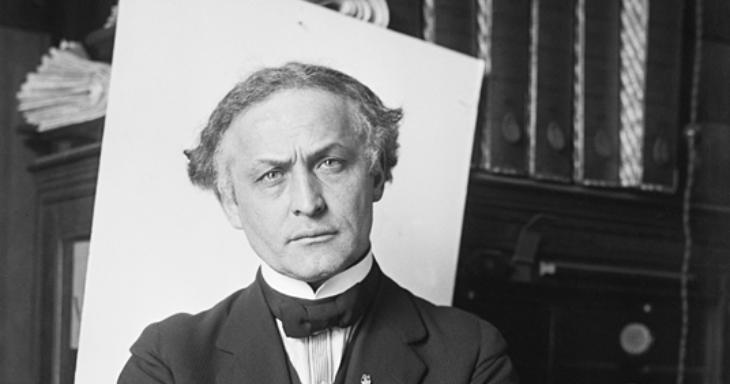
The correct answer is Harry Houdini. The world famous magician and escape artist died in Detroit on Halloween, October 31, 1926.
Harry Houdini was the world famous magician who died on Halloween in 1926. The legendary escape artist and illusionist died in Detroit on October 31, 1926, after complications connected to appendicitis and peritonitis. His death on Halloween added a haunting detail to a career already filled with danger, mystery, locked rooms, handcuffs, chains, and dramatic escapes.
Harry Houdini was born Erik Weisz in Budapest, Hungary, in 1874. His family immigrated to the United States when he was a child, and he grew up mostly in Wisconsin and New York. As a young performer, he became fascinated with magic, stagecraft, athletic stunts, and the art of escape. He later took the stage name Harry Houdini, partly inspired by the French magician Jean-Eugène Robert-Houdin, one of the most influential figures in the history of modern magic.
Houdini’s early career was not immediately successful. He performed in dime museums, sideshows, vaudeville circuits, and small theaters, often with his wife, Bess Houdini, as his stage partner. His career began to rise when he focused more strongly on escape acts rather than ordinary card tricks and illusions. Audiences were amazed by his ability to free himself from restraints that looked impossible to beat.
Handcuff escapes became one of Houdini’s trademarks. He challenged police departments to restrain him with their own cuffs, locks, and shackles. These public challenges helped build his reputation because they made his escapes seem more authentic and less like prepared stage tricks. If local police officers locked him up and he still escaped, the audience saw it as a real test of skill, strength, and nerve.
Houdini became famous for escaping from locked containers, jail cells, ropes, chains, straitjackets, and sealed boxes. Some of his most memorable feats involved water. In the Chinese Water Torture Cell, he was suspended upside down and lowered into a tank filled with water, his feet locked in stocks. In other escapes, he was placed in crates, milk cans, or boxes and submerged or sealed inside. The danger was part of the appeal, but Houdini was also a disciplined planner who understood locks, breathing control, body positioning, and showmanship.
His success came from more than physical ability. Houdini was a brilliant self-promoter. He used newspapers, posters, public demonstrations, and dramatic challenges to keep his name in front of the public. Before a theater performance, he might escape from a straitjacket while hanging upside down from a building, drawing huge crowds in the street. These stunts turned cities into part of the show before people even entered the theater.
Houdini also worked in films and became interested in aviation, but his lasting fame came from magic and escapes. Later in life, he devoted considerable energy to exposing fraudulent spiritualists and mediums. After World War I, many grieving families were drawn to people who claimed they could contact the dead. Houdini believed many of these mediums were using tricks to exploit vulnerable people. He attended séances, studied their methods, and publicly revealed how some effects were produced.
The story of Houdini’s death is often surrounded by myth, so the facts matter. He became ill in October 1926 while touring. A commonly repeated account says that a university student struck him in the abdomen after asking whether Houdini could withstand punches to the stomach. Houdini was known for demonstrating his strong abdominal muscles, but he may not have been prepared for the blows. The exact role of that incident in his death has been debated. What is clear is that Houdini developed appendicitis, and the condition worsened into peritonitis, a serious infection of the abdominal lining.
Despite feeling very sick, Houdini continued performing. He appeared in Detroit while in severe pain and was later taken to Grace Hospital. Doctors operated, but his infection had progressed too far. He died on October 31, 1926, at the age of 52. The date of his death, Halloween, quickly became part of his legend because it seemed to fit the eerie public image surrounding magic, spirits, escapes, and death-defying performances.
After his death, Houdini’s name remained one of the most recognizable in entertainment history. Magicians and escape artists continued to study his methods, his publicity skills, and his ability to make audiences believe they were witnessing something genuinely impossible. His career helped define the modern image of the magician as a daring performer, not just someone doing tricks on a stage.
The answer is Harry Houdini. He was the world famous magician, escape artist, and illusionist who died in Detroit on Halloween, October 31, 1926, after complications connected to appendicitis and peritonitis.
Start a 10-question trivia challenge and see how many actors, singers, inventors, presidents, authors, athletes, and historical figures you know.
Start the Challenge