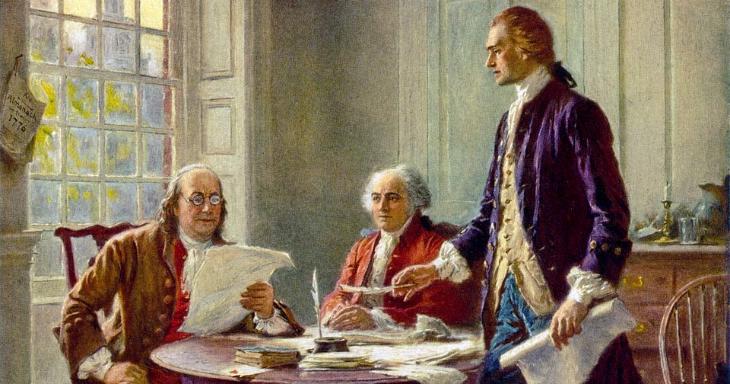
The correct answer is the Declaration of Independence. The famous U.S. document begins with the words “When in the Course of human events” and was adopted by the Continental Congress on July 4, 1776.
The Declaration of Independence is the famous U.S. document that begins with the words “When in the Course of human events.” Adopted by the Continental Congress on July 4, 1776, it announced that the thirteen American colonies considered themselves independent from Great Britain. The document became one of the central texts in American history, not only because it declared independence, but because it stated broad principles about liberty, government, rights, and the consent of the governed.
The opening phrase, “When in the Course of human events,” gives the document a formal and serious tone from the very first line. It suggests that the colonies were not acting on impulse, but responding to a major historical moment. The Declaration presents independence as something that needed to be explained to the world. That is why the first paragraph says that when one people must separate from another, they should declare the causes that led them to do so.
The document was primarily written by Thomas Jefferson, who was part of a five-member committee chosen to prepare a statement of independence. The committee also included John Adams, Benjamin Franklin, Roger Sherman, and Robert R. Livingston. Jefferson drafted the main text, and the Continental Congress edited it before adoption. Some of Jefferson’s wording was changed, and some passages were removed, but the final document still strongly reflected his style and argument.
The most famous section comes shortly after the opening. It states that “all men are created equal” and that they are endowed with “certain unalienable Rights,” including “Life, Liberty and the pursuit of Happiness.” Those words became some of the most quoted in American history. At the time, they were written as part of a political argument against British rule. Over time, they also became a standard by which later Americans challenged the country to live up to its own ideals.
The Declaration of Independence has three main parts. First, it gives a philosophical argument about the rights of people and the purpose of government. Second, it lists grievances against King George III, accusing him of abuses of power and violations of colonial rights. Third, it formally declares that the colonies are “Free and Independent States.” This structure gave the document both moral force and legal purpose. It was not just a patriotic statement. It was a public explanation for a revolutionary break.
The grievances against the king were meant to show that independence was justified. The colonists accused the British crown of blocking laws, dissolving legislatures, keeping standing armies in peacetime, interfering with trade, imposing taxes without consent, and denying trial by jury in some circumstances. Whether viewed from the American or British side, the list shows how deeply the conflict had moved beyond a disagreement over a single tax or policy. By 1776, many colonial leaders believed reconciliation was no longer realistic.
The Declaration was adopted during the American Revolutionary War, which had already begun in 1775 at Lexington and Concord. Independence did not instantly create the United States as a secure nation. The war continued for years, and the outcome was far from certain. The document’s importance lies partly in that risk. The men who approved and signed it were making a public commitment to a cause that could have failed.
Although July 4 is celebrated as Independence Day, the voting process began before that date. On July 2, 1776, Congress voted in favor of independence. On July 4, it approved the final wording of the Declaration. The best-known signed copy is the engrossed parchment version, which includes the large signature of John Hancock, president of the Continental Congress. His name became so closely associated with signing that “John Hancock” later became a common expression for a signature.
The Declaration of Independence remains housed and displayed by the National Archives in Washington, D.C., along with the Constitution and the Bill of Rights. Its opening words, “When in the Course of human events,” continue to identify one of the most important documents in U.S. history and one of the clearest statements of the American founding.
Start a 10-question trivia challenge and see how many famous events, documents, presidents, and historic moments you know.
Start the Challenge