American History Trivia Question
A Revolutionary War history question about the 1783 peace treaty that recognized American independence.
Question

Which important treaty, signed in 1783, officially ended the American Revolutionary War?

Correct Answer
Treaty of Paris

The correct answer is the Treaty of Paris. Signed in 1783, it officially ended the American Revolutionary War and recognized the independence of the United States.

Like American history trivia?
Start a 10-question trivia challenge beginning with a question like this. No signup needed to begin.
Start the Challenge
Why the Treaty of Paris Is the Correct Answer

The Treaty of Paris was the important treaty signed in 1783 that officially ended the American Revolutionary War. More specifically, it is often called the Treaty of Paris of 1783 to distinguish it from other treaties signed in Paris at different times in history. The agreement formally recognized the independence of the United States from Great Britain and marked the legal end of the war that had begun in 1775.

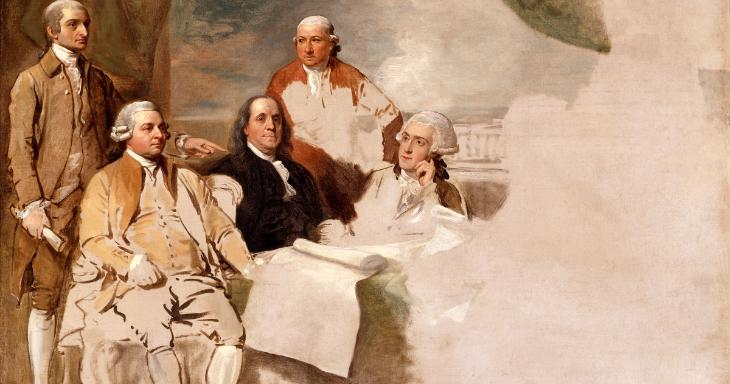
The treaty was signed on September 3, 1783, in Paris, France. The American negotiators were Benjamin Franklin, John Adams, and John Jay, three of the most important diplomatic figures of the Revolutionary era. Great Britain was represented by David Hartley, a British politician who supported a negotiated peace. The war had already effectively ended after the British defeat at Yorktown in 1781, but the Treaty of Paris provided the formal diplomatic settlement that made American independence official.

One of the treaty’s most important terms was Britain’s recognition that the United States was a free, sovereign, and independent nation. This was a major achievement for the former thirteen colonies. Before the treaty, Americans had declared independence in 1776, fought a long war to defend it, and gained critical military support from France. The treaty made that independence internationally recognized by the country from which the colonies had broken away.

The Treaty of Paris also established generous boundaries for the new United States. The western boundary was set at the Mississippi River, giving the country far more territory than just the original Atlantic seaboard colonies. The northern boundary was drawn with British Canada, while the southern boundary reached Spanish Florida. These borders gave the United States control over a vast area east of the Mississippi, creating the foundation for later westward expansion.

Fishing rights were another important part of the agreement. American fishermen received rights to fish off Newfoundland and in parts of the Gulf of Saint Lawrence. This mattered greatly to New England, where fishing had long been a major part of the economy. The negotiators understood that independence was not only about political recognition. The new country also needed economic rights that would help it survive.

The treaty also addressed debts and property issues, though these provisions caused disputes later. Creditors on both sides were supposed to be allowed to recover debts owed before the war. Congress was also to recommend that states restore property confiscated from Loyalists, colonists who had remained loyal to the British crown. In practice, many states resisted returning Loyalist property, and this became one of several sources of tension between the United States and Britain after the war.

The Treaty of Paris did not solve every problem. British forts remained in parts of the Northwest Territory for years, and relations between the two countries stayed uneasy. Native nations, whose lands were affected by the new boundaries, were not included as equal negotiating parties. For many Indigenous peoples, the treaty transferred British claims to the United States without their consent, setting up future conflict over land and sovereignty. That part of the treaty’s legacy is important because the agreement shaped the map, but it did not settle the human realities of the frontier.

For the United States, the Treaty of Paris was a diplomatic victory. Franklin, Adams, and Jay secured independence, broad borders, and economic rights at a moment when the new nation was still fragile. The Articles of Confederation government had limited power, the war had left heavy debts, and the country still had to prove it could govern itself. The treaty gave the United States the international standing needed to begin that next stage.

The correct answer is the Treaty of Paris. It officially ended the American Revolutionary War, recognized American independence, and helped define the early borders of the United States. 

More American History Trivia Questions

Ready for another challenge?

Start a 10-question trivia challenge and see how many famous events, documents, presidents, and historic moments you know.

Start the Challenge