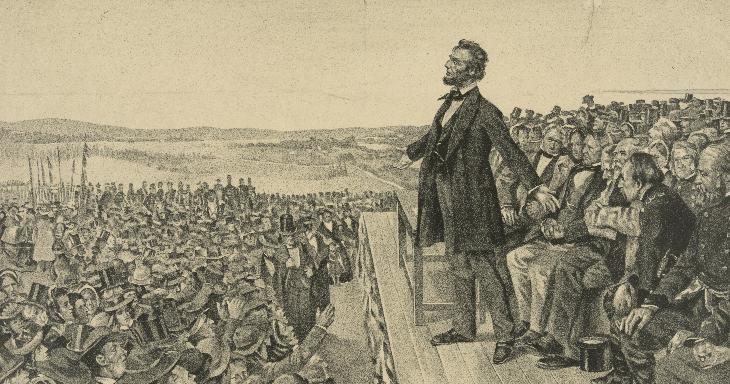
American History Trivia Question
A Civil War history question about the Gettysburg Address and the president who delivered it.
Question

Which US President delivered the famous "Gettysburg Address" during the Civil War in 1863?

Correct Answer
Abraham Lincoln

The correct answer is Abraham Lincoln. He delivered the Gettysburg Address on November 19, 1863, during the Civil War at the dedication of the Soldiers’ National Cemetery in Gettysburg, Pennsylvania.

Like American history trivia?
Start a 10-question trivia challenge beginning with a question like this. No signup needed to begin.
Start the Challenge
Why Abraham Lincoln Is the Correct Answer

Abraham Lincoln delivered the famous Gettysburg Address during the Civil War in 1863. He gave the speech on November 19, 1863, at the dedication of the Soldiers’ National Cemetery in Gettysburg, Pennsylvania. The cemetery was created to honor Union soldiers who died in the Battle of Gettysburg, one of the bloodiest and most important battles of the American Civil War. Lincoln’s remarks were brief, but they became one of the most important speeches in United States history.

The Battle of Gettysburg had taken place several months earlier, from July 1 to July 3, 1863. Confederate General Robert E. Lee had led the Army of Northern Virginia into Pennsylvania, hoping a victory on Northern soil might weaken Union morale and possibly influence foreign opinion. Union forces under General George G. Meade stopped Lee’s army at Gettysburg after three days of fierce fighting. The battle ended with Lee’s retreat back into Virginia and is often described as a major turning point in the Civil War.

The human cost was enormous. More than 50,000 soldiers were killed, wounded, captured, or missing during the battle. Afterward, the town of Gettysburg was left with the grim task of caring for the dead and wounded. The creation of a national cemetery became part of the effort to properly bury Union soldiers and give meaning to their sacrifice. Lincoln was invited to offer a few remarks at the dedication ceremony, while the main speech was given by Edward Everett, one of the most famous orators of the time.

Everett spoke for about two hours, which was common for major public ceremonies in the 19th century. Lincoln’s speech lasted only a few minutes. It began with the now famous words, “Four score and seven years ago,” referring to 87 years earlier, when the Declaration of Independence was adopted in 1776. In just a short address, Lincoln connected the Civil War to the founding principle that “all men are created equal.” He framed the war not only as a fight to preserve the Union, but as a test of whether a nation built on liberty and equality could survive.

The Gettysburg Address is powerful because of its clarity and structure. Lincoln did not focus on military details or personal glory. He spoke about the past, the present, and the future. The past was the nation’s founding. The present was the battlefield and the cemetery where fallen soldiers were being honored. The future was the unfinished work of preserving democratic government and giving the country “a new birth of freedom.” That phrase gave the speech a deeper meaning in the context of slavery, emancipation, and the future of the United States.

Lincoln also said that the living could not truly dedicate or consecrate the ground because the soldiers who fought there had already done so by their actions. This was one of the speech’s most memorable ideas. The ceremony mattered, but the sacrifice of the dead mattered more. Lincoln used that point to shift responsibility onto the living. He argued that Americans had to continue the work for which the soldiers had given their lives.

The final words of the Gettysburg Address became especially famous: “government of the people, by the people, for the people, shall not perish from the earth.” That line turned the speech into a lasting statement about democracy itself. Lincoln was speaking during a war, but the words reached beyond the battlefield. They became a definition of democratic government and a reminder that self-government can survive only if people defend it.

At the time, reaction to the speech was mixed. Some newspapers praised it, while others criticized it or gave it little attention. Over time, its reputation grew. Today, it is carved into the Lincoln Memorial in Washington, D.C., and is studied in schools, quoted by public leaders, and remembered as one of the finest examples of American political speech.

The correct answer is Abraham Lincoln. The Gettysburg Address remains closely tied to his presidency, the Civil War, the Battle of Gettysburg, the meaning of the Union, and the promise of freedom in American history.

More American History Trivia Questions

Ready for another challenge?

Start a 10-question trivia challenge and see how many famous events, documents, presidents, and historic moments you know.

Start the Challenge