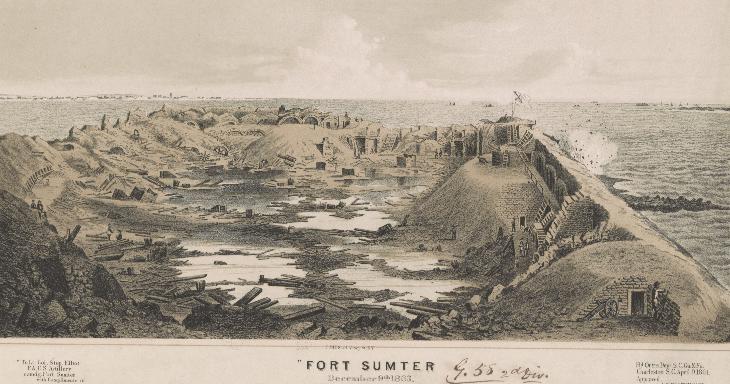
The correct answer is Fort Sumter. Located in Charleston Harbor, South Carolina, Fort Sumter was attacked by Confederate forces on April 12, 1861, marking the first shots of the Civil War.
Fort Sumter is the historic fort in South Carolina known as the site of the first shots of the Civil War. Located in Charleston Harbor, Fort Sumter became the place where the long political crisis over slavery, secession, and federal authority finally turned into open war. The attack began on April 12, 1861, when Confederate forces fired on the Union-held fort. That bombardment marked the start of the American Civil War.
Fort Sumter was built as a coastal defense fortification after the War of 1812, when the United States strengthened its harbor defenses. It sits on an artificial island near the entrance to Charleston Harbor, positioned to help guard one of the South’s most important ports. By 1860 and 1861, the fort was not only a military installation. It had become a symbol of whether the federal government still had authority in states that had declared themselves separate from the Union.
The crisis began after Abraham Lincoln was elected president in November 1860. South Carolina seceded from the United States on December 20, 1860, becoming the first state to do so. Several other Southern states soon followed. Federal property inside seceded states became a major problem almost immediately. South Carolina claimed that forts and other federal installations in the state should be turned over to the new Confederate authorities. The U.S. government refused to give them up.
At the time, Major Robert Anderson commanded a small Union garrison in Charleston. Anderson moved his men from Fort Moultrie, which was more vulnerable, to Fort Sumter on December 26, 1860. That move angered South Carolina leaders, who saw it as a refusal to surrender federal control. Fort Sumter soon became the focus of national attention. The fort was isolated, short on supplies, and surrounded by Confederate batteries in Charleston Harbor.
When Lincoln took office in March 1861, he faced a dangerous choice. If he abandoned Fort Sumter, it could look like the federal government was accepting secession. If he tried to reinforce it with troops, it could provoke war. Lincoln decided to send supplies rather than soldiers, presenting the mission as an effort to feed the garrison rather than attack the South. Confederate leaders, unwilling to allow the fort to be resupplied, demanded its surrender.
When Anderson refused to surrender, Confederate forces opened fire before dawn on April 12, 1861. The bombardment lasted for about 34 hours. Confederate guns fired from positions around the harbor, including Fort Moultrie, Cummings Point, and other nearby batteries. The Union soldiers inside Fort Sumter returned fire, but they were badly outmatched. Smoke, fire, and damage spread through the fort as the attack continued.
No soldiers were killed during the bombardment itself, which is a surprising detail given the importance of the event. After the fort surrendered, a Union cannon accident during a salute killed one soldier and mortally wounded another. Even though the first battle had limited casualties, its consequences were enormous. Lincoln called for volunteers to put down the rebellion, and more Southern states seceded after that call. The conflict quickly expanded from a standoff over one fort into a full-scale civil war.
Fort Sumter remained important throughout the war. Confederate forces held it for most of the conflict, while Union forces repeatedly attacked Charleston Harbor. The fort was heavily damaged by later bombardments, and by the end of the war it was a battered ruin compared with its earlier form. Charleston was eventually evacuated by Confederate troops in February 1865, and Union forces raised the U.S. flag over Fort Sumter again.
Today, Fort Sumter is part of Fort Sumter and Fort Moultrie National Historical Park. Visitors can reach it by boat from Charleston and see the remains of the fort, museum exhibits, cannons, and views of Charleston Harbor. The site is preserved not because it was the largest battle or the bloodiest battlefield, but because it marks the moment when the Civil War began.
The correct answer is Fort Sumter. Its location in Charleston Harbor, South Carolina, and its role in the April 1861 bombardment make it one of the most significant Civil War landmarks in the United States.
Start a 10-question trivia challenge and see how many famous events, documents, presidents, and historic moments you know.
Start the Challenge