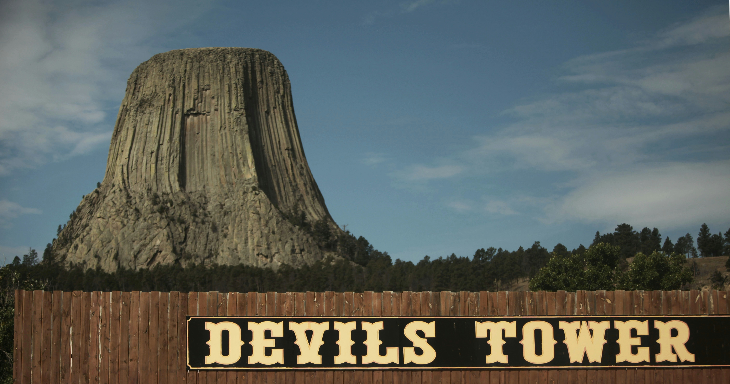
The correct answer is Wyoming. Devils Tower is located in northeastern Wyoming and became the first U.S. national monument in 1906.
Wyoming is the U.S. state where Devils Tower is located. Devils Tower was named the first U.S. national monument in 1906, when President Theodore Roosevelt protected it under the newly passed Antiquities Act. The monument rises dramatically from the rolling landscape of northeastern Wyoming, near the Belle Fourche River and not far from the borders of South Dakota and Montana. Its unusual shape, steep sides, and flat top have made it one of the most recognizable natural landmarks in the American West.
Devils Tower is a massive rock formation that stands about 867 feet above its base and more than 1,200 feet above the Belle Fourche River. From a distance, it looks like a giant stone tower emerging from forests and grasslands. Its sides are marked by long vertical columns, giving it a grooved appearance that looks almost carved by hand. Those columns are one of the reasons the formation is so visually striking and so different from the surrounding hills.
Geologists generally explain Devils Tower as an igneous formation, meaning it was created from molten rock that cooled and hardened underground. Over time, the softer surrounding rock eroded away, leaving the harder tower exposed. The exact details of its formation have been debated, but the broad idea is clear: erosion revealed a much tougher body of rock that had formed long before it became visible at the surface. The vertical columns formed as the rock cooled and contracted, creating cracks in a pattern known as columnar jointing.
The name “Devils Tower” came from an English-language interpretation that many Native people and historians have criticized as a mistranslation. Several Native nations have traditional names for the formation that refer to bears, including names often translated as Bear Lodge, Bear’s Tipi, or Bear Lodge Butte. The site is sacred to many Plains tribes, including the Lakota, Cheyenne, Crow, Kiowa, Arapaho, and Shoshone. Long before it became a national monument, it was part of Native spiritual traditions, ceremonies, stories, and cultural memory.
One widely known Native story connected to the tower involves children escaping a giant bear. In versions of the story, the children climb onto a rock, which rises into the sky to protect them. The bear claws at the sides, leaving the long grooves that can still be seen on the formation today. Different tribes tell different versions, but the recurring connection between the tower and bears helps explain why many Native names for the place are bear-related.
Devils Tower became a national monument because of its scientific interest, scenic value, and cultural importance. The Antiquities Act of 1906 gave presidents the authority to protect landmarks, structures, and objects of historic or scientific interest on federal land. Roosevelt used that power to designate Devils Tower on September 24, 1906. That action made it the first protected site of its kind in the United States and helped begin a long national monument tradition that later included many historic, archaeological, and natural places.
The monument is also famous among rock climbers. The vertical cracks in its columns provide climbing routes, and climbers have been drawn to the tower for generations. At the same time, climbing is a sensitive issue because of the tower’s sacred meaning to Native communities. A voluntary climbing closure is encouraged each June, when many Native ceremonies are held. This effort reflects the challenge of balancing recreation with respect for cultural and spiritual traditions.
Devils Tower also became widely recognized through popular culture. It appeared prominently in the 1977 film Close Encounters of the Third Kind, which introduced the landmark to many viewers who had never seen it before. The film used the tower’s strange and dramatic profile to great effect, strengthening its image as a mysterious and unforgettable place.
The correct answer is Wyoming. Devils Tower’s status as the first U.S. national monument, its striking geology, its deep Native cultural significance, and its dramatic western setting make it one of the most important landmarks in the state.
Start a 10-question trivia challenge and see how many states, landmarks, parks, and famous places you know.
Start the Challenge