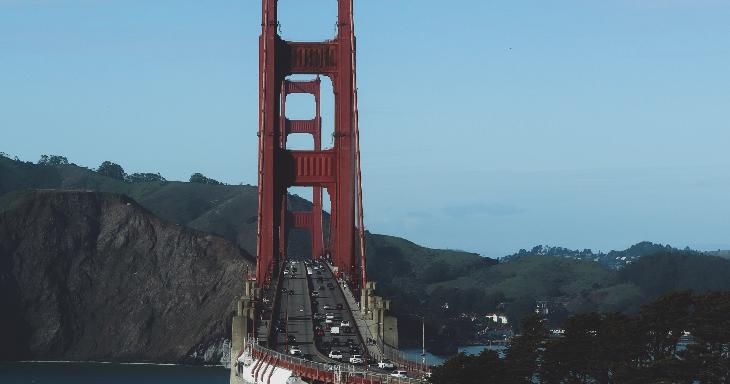
The correct answer is six. The Golden Gate Bridge has six traffic lanes carrying vehicles between San Francisco and Marin County.
Six traffic lanes are on the iconic Golden Gate Bridge, the world-famous suspension bridge that connects San Francisco to Marin County in northern California. The bridge carries U.S. Route 101 and California State Route 1 across the Golden Gate Strait, the narrow waterway linking San Francisco Bay with the Pacific Ocean. Its six vehicle lanes are one of the practical details behind a landmark that is often remembered more for its sweeping towers, orange color, foggy setting, and dramatic views.
The Golden Gate Bridge opened to traffic in 1937, during the Great Depression, and quickly became one of the most recognizable bridges in the world. Before it was built, many people doubted whether a bridge could safely span the Golden Gate. The strait had strong tides, deep water, heavy winds, and frequent fog. Engineers had to design a bridge strong enough to handle difficult natural conditions while also providing a reliable transportation link between San Francisco and the communities to the north.
The bridge’s roadway was built with six lanes for motor vehicles. What makes those lanes especially interesting is that their direction can be changed depending on traffic demand. During heavy commute periods, more lanes can be assigned to traffic heading in the busier direction. For example, in the morning, more lanes may be directed southbound toward San Francisco. Later in the day, the pattern can shift to help northbound traffic leave the city. This reversible-lane system helps the bridge handle large traffic volumes within the fixed width of the roadway.
For many years, lane direction was controlled with movable lane markers, which meant the center divide between opposing traffic was not a permanent concrete barrier. That changed in 2015, when the Golden Gate Bridge received a movable median barrier. This barrier can be shifted by a special machine, allowing officials to change lane configurations while giving drivers a stronger physical separation from oncoming traffic. The system improved safety while preserving the flexibility of the bridge’s six-lane layout.
The Golden Gate Bridge is also used by pedestrians and bicyclists, though those paths are separate from the six vehicle lanes. Sidewalks on the east and west sides of the bridge allow people to walk or bike across at designated times. The east sidewalk is especially popular with visitors because it offers views of San Francisco, Alcatraz Island, the bay, and the bridge towers. The bridge is not only a transportation route. It is also one of the most visited landmarks in California.
The bridge’s color is officially known as International Orange. It was not chosen simply to look pretty in photographs. The color helps the bridge stand out against the surrounding water, hills, sky, and fog. It also became a defining part of the bridge’s identity. Combined with its Art Deco details, tall towers, sweeping cables, and coastal setting, the color makes the Golden Gate Bridge instantly recognizable.
The bridge’s main span is 4,200 feet long, and at the time it opened, it had the longest suspension bridge main span in the world. Its two towers rise 746 feet above the water, giving the structure its powerful vertical profile. The bridge was an engineering achievement as well as a civic symbol, showing what could be built despite economic hardship and technical doubts.
Traffic on the Golden Gate Bridge has changed over the decades, but the six-lane roadway remains central to its function. Millions of vehicles cross it each year, linking San Francisco with Marin County, the North Bay, and routes toward coastal and wine country destinations. Ferries, buses, and nearby highways also serve the region, but the bridge remains the most famous crossing.
The correct answer is six traffic lanes. The Golden Gate Bridge is admired for its beauty and history, but its six-lane roadway is what allows it to keep serving as a major transportation link nearly a century after it opened.
Start a 10-question trivia challenge and see how many states, landmarks, parks, and famous places you know.
Start the Challenge