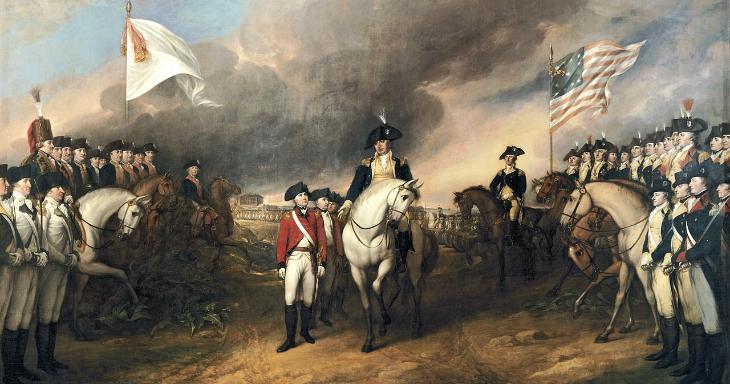
The correct answer is the British surrender at Yorktown. On October 19, 1781, British forces under Lord Cornwallis surrendered at Yorktown, Virginia, effectively ending major fighting in the American Revolutionary War.
The British surrender at Yorktown on October 19, 1781, was the decisive event that effectively ended the American Revolutionary War. The surrender took place at Yorktown, Virginia, after British General Lord Charles Cornwallis and his army were trapped by American and French forces. Although the war did not officially end until the Treaty of Paris in 1783, Yorktown destroyed Britain’s best chance of winning the conflict and pushed the British government toward peace negotiations.
The Yorktown campaign was a major turning point because it combined land and sea power at exactly the right moment. American forces under George Washington and French forces under Jean-Baptiste Donatien de Vimeur, comte de Rochambeau, marched south from the New York area toward Virginia. Their goal was to trap Cornwallis, who had moved his army to Yorktown, a port town on the Virginia Peninsula. Cornwallis expected that British naval support could protect him or evacuate his troops if necessary. That expectation failed.
The key to the trap was the French fleet under Admiral François Joseph Paul de Grasse. In September 1781, French ships fought the British at the Battle of the Chesapeake, also known as the Battle of the Virginia Capes. The French prevented the British navy from reaching Cornwallis. That gave Washington and Rochambeau time to surround Yorktown by land while the French blocked escape by sea. Cornwallis was boxed in, with no practical way out.
The siege began in late September 1781. American and French troops dug trenches and advanced closer to the British defenses. Artillery fire battered the British positions day and night. Two important British redoubts, numbered 9 and 10, were captured on October 14. The capture of those defenses allowed the allied forces to move their artillery closer and increase the pressure on Cornwallis. With his army weakening, his defenses crumbling, and no rescue coming, Cornwallis had little choice but to surrender.
On October 19, 1781, the British army formally surrendered. Cornwallis claimed illness and did not personally attend the main surrender ceremony, sending General Charles O’Hara in his place. O’Hara first tried to surrender to the French commander Rochambeau, but Rochambeau directed him to Washington. Washington then had O’Hara surrender to American General Benjamin Lincoln, a deliberate gesture connected to Lincoln’s earlier surrender at Charleston in 1780. The symbolism was clear. A British army that had once seemed capable of crushing the rebellion was now handing over its arms to the Americans and their French allies.
Yorktown did not mean every British soldier immediately left America. Fighting and occupation continued in some areas, and British forces still held cities such as New York for a time. The political effect, though, was enormous. News of Cornwallis’s surrender reached Britain and badly weakened support for continuing the war. The British public and Parliament had already grown tired of the cost, distance, and difficulty of fighting in America. Yorktown made it clear that victory would be far harder than British leaders had hoped.
The surrender also showed the importance of the French alliance. The American Revolution was not won by the Continental Army alone. French troops, French money, French supplies, and especially French naval power were crucial at Yorktown. Without the French fleet blocking the Chesapeake, Cornwallis may have been rescued or reinforced. The victory proved that the alliance had become a decisive factor in the war.
For George Washington, Yorktown was the military success he had long needed. He had kept the Continental Army together through years of hardship, retreats, shortages, and uncertainty. At Yorktown, patience and coordination paid off. The victory did not just defeat one army. It confirmed that the United States could survive as an independent nation.
The correct answer is the British surrender at Yorktown. It effectively ended the American Revolutionary War because it forced Britain to accept that the rebellion could not be easily defeated and opened the way to the peace settlement that formally recognized American independence in 1783.
Start a 10-question trivia challenge and see how many famous events, documents, presidents, and historic moments you know.
Start the Challenge