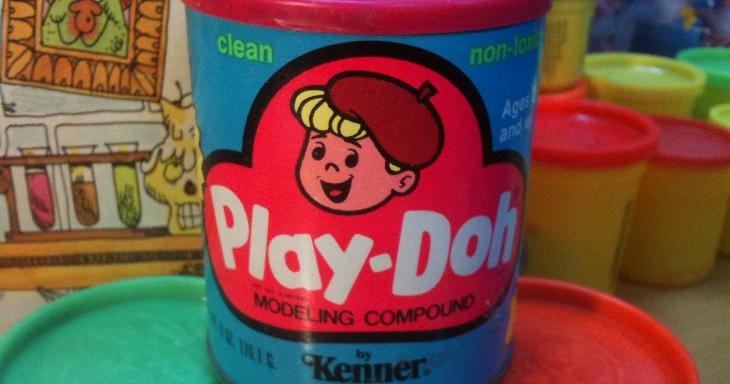
The correct answer is Play-Doh. Before it became a popular children’s modeling compound, Play-Doh was originally made as a putty-like cleaner for removing soot and dirt from wallpaper.
Play-Doh is the 1950s toy that was originally made to clean wallpaper and later became a hit when children began using it to make shapes. Before it became one of the most familiar modeling compounds in American homes and classrooms, Play-Doh had a very different purpose. It was first developed as a soft, putty-like cleaner used to remove soot and dirt from wallpaper, especially in homes heated by coal furnaces.
The original product was made by a Cincinnati-based company connected to Kutol Products, a soap and cleaning supply business. In the early 20th century, many homes had wallpaper, and coal heat often left a dark residue on walls. A soft cleaning compound could be rolled across the surface to lift grime without damaging the paper. That was useful at the time, but the market changed after World War II. More homes switched from coal heat to oil, gas, or electric heating, which produced less soot. Washable vinyl wallpaper also became more common. As those changes spread, demand for wallpaper cleaner fell sharply.
The product’s second life came through children. Joseph McVicker, who worked with the family business, learned that a nursery school teacher had been using the compound in the classroom as a modeling material. The soft dough was easier for young children to handle than traditional modeling clay. It was smooth, pliable, and did not stain as badly as some other art materials. Most importantly, kids enjoyed shaping it. That classroom discovery helped turn a fading cleaning product into a toy.
The product was reformulated and marketed for children under the name Play-Doh in the 1950s. It was first sold as a modeling compound rather than a cleaner, and its appeal was immediate. Children could roll it, flatten it, cut it, squeeze it, and form simple figures without needing special tools. Parents and teachers liked it because it encouraged hands-on creativity. It could be used at home, in preschool classrooms, and later in elementary schools for art and sensory play.
One of the reasons Play-Doh became so successful was its simplicity. It didn’t require batteries, rules, a board, or complicated instructions. A child could open a can and start making something right away. That made it different from many structured toys. It gave children the freedom to create pretend food, animals, letters, shapes, buildings, and anything else they could imagine. The material was forgiving too. If a shape didn’t turn out right, it could be squashed and started again.
Television helped Play-Doh grow into a national brand. In the 1950s, children’s television advertising was becoming a powerful force in toy sales. Play-Doh was promoted on popular programs, which helped introduce it to families across the United States. The product’s bright packaging and playful name helped distance it from its earlier identity as wallpaper cleaner. By the time many families encountered it, they knew it only as a toy.
The classic Play-Doh smell also became part of its identity. Many people remember the scent almost as much as the texture. That sensory connection helped make the toy memorable across generations. Later, Play-Doh was sold in multiple colors and paired with molds, presses, cutters, and playsets. Sets that allowed children to make pretend meals, shapes, or characters expanded the brand while keeping the basic idea the same.
Play-Doh eventually became part of the Hasbro toy family and remained a staple of childhood play. Its story is a strong example of a product finding a new purpose after its original market disappeared. What began as a household cleaning compound became one of the best-known creative toys of the 20th century.
Start a 10-question trivia challenge and see how many classic toys, board games, puzzles, and childhood favorites you know.
Start the Challenge