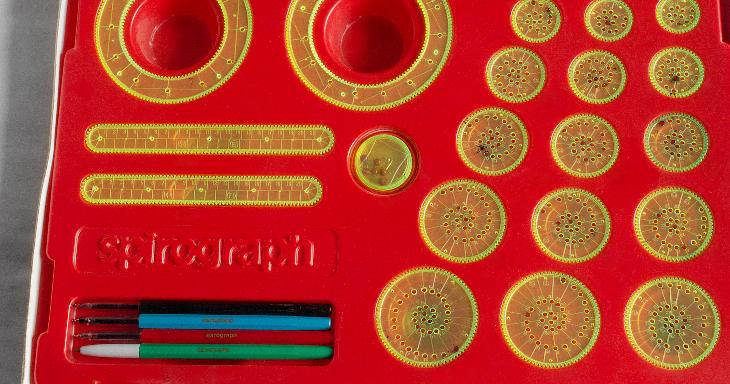
The correct answer is Spirograph. First sold in the 1960s, it uses plastic gears and pens to create spiral, geometric, and repeating pattern designs.
Spirograph is the classic drawing toy, first sold in the 1960s, that uses plastic gears and pens to create spiral and geometric patterns. The toy became famous because it allowed children to make designs that looked far more complex than ordinary freehand drawings. By placing a pen through holes in small plastic wheels and moving those wheels around or inside larger rings, users could create smooth loops, rosettes, spirals, starbursts, and repeating curves with surprising precision.
Spirograph was introduced commercially in the 1960s and became one of the best-known creative toys of that decade. It was developed by British engineer Denys Fisher, who originally worked on mechanical drawing ideas before turning the concept into a toy. The appeal was immediate. A child did not need to be especially skilled at drawing to produce a polished design. The gears did much of the work, while the user chose the colors, hole positions, wheel sizes, and pattern combinations.
The basic Spirograph set included plastic rings, toothed wheels, pins, paper, and pens. The outer ring or straight track was usually pinned to the paper or held in place. A smaller gear was then placed against its teeth. As the user moved the smaller gear around the inside or outside of the larger shape, the pen traced a repeating mathematical curve. The result depended on the size of the gears, the hole used for the pen, and how far the wheel traveled before returning to its starting point. Changing any one of those choices could create a very different design.
Part of Spirograph’s lasting appeal is that it feels like both art and science. The patterns are beautiful, but they are also based on geometry. The toy creates curves known as hypotrochoids and epitrochoids, though most children never needed to know those words to enjoy it. A hypotrochoid is formed when a point attached to a circle rolls inside another circle. An epitrochoid is formed when it rolls around the outside. In simple terms, the gears turn math into drawings.
Spirograph fit well with the visual style of the 1960s and 1970s. Its colorful, repeating patterns matched the era’s interest in bold graphics, posters, album art, and decorative design. Finished Spirograph drawings could look like flowers, snowflakes, fireworks, mandalas, or mechanical diagrams. Many children used different colored pens to layer designs on top of one another, creating bright, intricate artwork that looked impressive on a refrigerator door or classroom wall.
The toy also encouraged patience and careful hand control. If the gear slipped, the pattern could jump out of alignment and spoil the drawing. That was part of the challenge. A good Spirograph design required a steady motion, gentle pressure, and enough focus to guide the gear until the loop was complete. The reward was watching the pattern slowly build, one curved line at a time, until the full shape appeared.
Spirograph was not an electronic toy, and it did not need sound, lights, or batteries to hold attention. Its strength came from a simple mechanical idea that produced endless variation. A few plastic gears could create hundreds of possible designs. That made it economical, reusable, and easy to share among siblings, classmates, or friends.
Over the years, Spirograph has been released in many versions, including travel sets, deluxe kits, themed editions, and modern updated packages. The core idea has stayed the same because it still works. Plastic gears, paper, and pens remain enough to create patterns that feel almost magical, especially the first time someone sees a simple circular motion turn into a perfectly balanced design.
Start a 10-question trivia challenge and see how many classic toys, board games, puzzles, and childhood favorites you know.
Start the Challenge