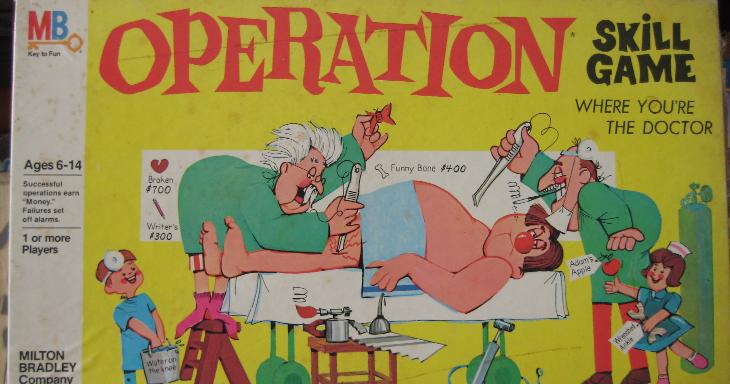
The correct answer is Operation. First released in the 1960s, the game has players use tweezers to remove pieces like the funny bone without touching the sides and setting off the buzzer.
Operation is the classic board game, first released in the 1960s, in which players remove pieces like a “funny bone” without setting off a buzzer. The game became one of the most recognizable skill-and-dexterity games of its era because its whole appeal rests on steady hands, suspense, and a simple joke: the players are pretending to perform surgery on a cartoon patient without touching the metal edges of each opening.
Operation was first introduced by Milton Bradley in 1965. The game’s patient, known as Cavity Sam, lies on an operating table with several openings in his body. Each opening contains a small plastic piece representing a silly ailment or body part. Players use tweezers to remove the pieces. If the tweezers touch the metal edge around the opening, an electrical circuit is completed, the buzzer sounds, and Sam’s red nose lights up. That sudden buzz is what made the game both funny and nerve-racking.
The “funny bone” is one of the best-known pieces in Operation, partly because it works as a pun. In real life, the funny bone refers to the ulnar nerve area near the elbow, where a bump can cause a strange tingling feeling. In the game, it becomes a removable object, treated as if it were an actual bone that needs to be taken out. Other classic pieces have included items such as Adam’s apple, broken heart, wish bone, spare ribs, butterflies in the stomach, writer’s cramp, water on the knee, and bread basket. The names are intentionally playful, mixing medical language with jokes and everyday expressions.
Operation’s design made it easy to understand immediately. There were no complicated rules, long setup, or deep strategy. The challenge was physical control. Players had to grip the tweezers carefully, lower them into a narrow opening, pinch the plastic piece, and lift it out without touching the sides. That made it accessible to children, parents, and grandparents, which helped it become a family favorite. The game could be silly for young kids, but still tense enough that adults could enjoy the challenge.
The game’s origins go back to a student project by John Spinello, who created an early version called Death Valley while studying industrial design. His concept used a wand and an electrified surface, rewarding careful hand control and punishing a slip with a buzzer. The idea was later developed into Operation, with the medical theme, cartoon patient, and humorous body-part names giving it the personality that people remember today. Spinello’s role in creating the concept became better known many years after the game had become a household name.
Part of Operation’s long-lasting appeal is that the game turns nervousness into entertainment. The closer a player gets to removing a piece, the more careful they become. The buzzer creates an instant reaction, often making everyone at the table laugh or jump. Unlike games that depend mostly on luck, Operation makes players feel personally responsible for success or failure. A shaky hand, a quick move, or a moment of overconfidence can set off the alarm.
The game also fit well with the toy trends of the 1960s. Battery-powered features were becoming more common in toys, and Operation used electronics in a simple, memorable way. The light-up nose and buzzer gave it an interactive quality that stood out on store shelves and in television commercials. It felt more active than a traditional board game, but still worked as a tabletop family game.
Over the decades, Operation has been released in many versions, including themed editions tied to popular movies, television shows, and characters. Even with those changes, the core idea has stayed the same. A player still uses tweezers, tries to remove a small piece, and hopes not to hear the buzzer.
Start a 10-question trivia challenge and see how many classic toys, board games, puzzles, and childhood favorites you know.
Start the Challenge