Classic Games & Toys Trivia Question
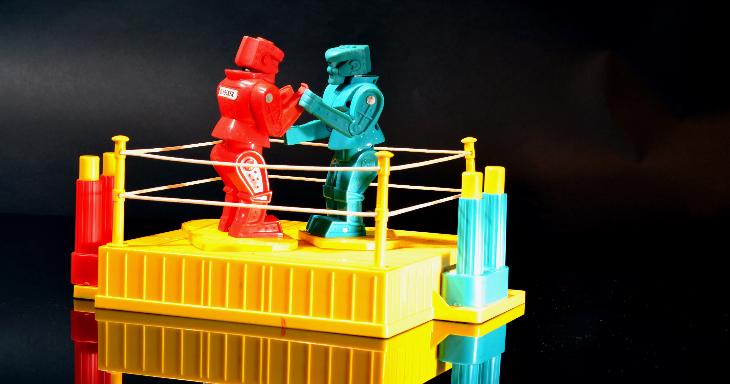
A classic toy question about two plastic robot fighters, button controls, and heads popping up.
Question

What 1950s toy featured two plastic fighters controlled by buttons, trying to knock each other’s heads off?

Correct Answer
Rock 'Em Sock 'Em Robots

The correct answer is Rock ’Em Sock ’Em Robots. The classic tabletop toy featured two plastic robot fighters controlled by buttons, with players trying to land a punch that made the opponent’s head pop up.

Like classic games and toys trivia?
Start a 10-question trivia challenge beginning with a question like this. No signup needed to begin.
Start the Challenge
Why Rock ’Em Sock ’Em Robots Is the Correct Answer

Rock ’Em Sock ’Em Robots is the 1950s toy that featured two plastic fighters controlled by buttons, trying to knock each other’s heads off. The toy was introduced by Marx in 1964, though it is often associated with the classic mid-century toy era because of its simple mechanical action, bold colors, and tabletop boxing setup. The original game featured two robot boxers, usually known as Red Rocker and Blue Bomber, standing inside a small boxing ring. Each player controlled one robot with a pair of hand-operated buttons or levers, moving the robot’s fists and trying to land a clean punch on the opponent’s head.

The appeal of Rock ’Em Sock ’Em Robots was immediate and easy to understand. There were no complicated rules to study, no board to move around, and no cards to read. Two players sat across from each other, grabbed the controls, and began punching. The goal was to strike the other robot’s chin or head with enough force that its head popped upward. When that happened, the successful player had “knocked his block off,” which became the toy’s most famous phrase.

The toy worked through a mechanical linkage system. The controls at the base of the ring connected to the robots’ arms and body movement. Players could make their robot punch with the left or right hand while also shifting position slightly. The robots were not electronic, and early versions did not need batteries. Everything depended on hand speed, timing, and the sturdy plastic mechanisms inside the toy. That gave it a physical, satisfying feel that many later electronic games could not quite replace.

Rock ’Em Sock ’Em Robots fit perfectly into the 1960s toy market. Children’s toys were becoming more action-oriented, and television advertising helped make memorable toys feel larger than life. A pair of brightly colored robots battling in a tiny boxing ring looked great in commercials and on store shelves. The toy also reflected the space-age and robot fascination of the period. Robots had appeared in science fiction films, comic books, television shows, and popular imagination, so turning them into boxing opponents was both funny and futuristic.

The names of the two robots added to the toy’s personality. Red Rocker and Blue Bomber were simple, colorful identities that made the fighters feel like characters rather than plain plastic pieces. Their square jaws, broad shoulders, and stiff fighting posture gave them a cartoonish toughness. The design was not meant to be realistic. It was exaggerated in a way that made the action clear and humorous.

Parents and kids also liked that Rock ’Em Sock ’Em Robots was competitive but contained within the toy itself. It gave children the excitement of a fight without roughhousing across the room. The action stayed on the tabletop. The dramatic head-popping feature made every round end with a clear result, and resetting the head was quick, so players could start again immediately. That repeatable challenge helped keep it popular.

Over the decades, Rock ’Em Sock ’Em Robots remained strongly nostalgic. It was later produced by other toy companies after ownership changed, including Mattel. The basic design has been updated in different versions, but the core idea has stayed the same: two robots, two players, quick punches, and one head popping up when a winning hit lands. The toy has also appeared in pop culture, cartoons, commercials, and references to old-fashioned childhood games.

More Classic Games & Toys Trivia Questions

Ready for another challenge?

Start a 10-question trivia challenge and see how many classic toys, board games, puzzles, and childhood favorites you know.

Start the Challenge