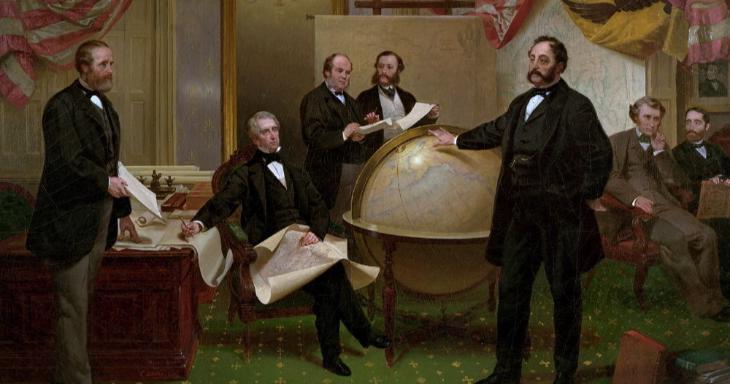
The correct answer is Alaska. The United States purchased Alaska from Russia on March 30, 1867, in a deal known as the Alaska Purchase.
Alaska was the U.S. territory purchased from Russia on March 30, 1867. The agreement is known as the Alaska Purchase, and it transferred Russian America to the United States for $7.2 million. At the time, many Americans did not fully understand the value of the land. Alaska seemed remote, frozen, difficult to reach, and far removed from the main centers of U.S. population. Over time, the purchase came to be seen as one of the most important land acquisitions in American history.
The deal was negotiated under President Andrew Johnson, but the U.S. official most closely associated with it was Secretary of State William H. Seward. Seward believed the United States should expand its influence across North America and into the Pacific. He saw Alaska not just as distant territory, but as a strategic and commercial opportunity. Russia, meanwhile, had reasons to sell. Its North American colony was costly to defend, difficult to supply, and vulnerable if war broke out with Britain, whose Canadian territories bordered the region.
The treaty was signed in Washington, D.C., on March 30, 1867. The purchase price of $7.2 million worked out to roughly two cents per acre, a figure often repeated because it makes the scale of the deal easy to grasp. The United States gained about 586,000 square miles, an enormous area that would later become the largest state in the country. The formal transfer took place on October 18, 1867, in Sitka, which had served as the capital of Russian America. That date is still remembered in Alaska as Alaska Day.
At first, the purchase was mocked by some critics. They called it names such as “Seward’s Folly” or “Seward’s Icebox,” suggesting that the United States had wasted money on frozen wilderness. Those phrases became famous, though the criticism was not universal. Some newspapers and political leaders supported the purchase from the beginning, especially because it expanded American territory and influence in the Pacific. Still, the nickname stuck because it captured the skepticism many people felt.
Alaska’s value became clearer over time. The territory held rich natural resources, including fish, timber, minerals, and later oil. In the late 19th century, gold discoveries in Alaska and nearby Yukon helped bring thousands of prospectors north. The Klondike Gold Rush of the 1890s made the region much more famous and showed that the far north could attract enormous economic interest. Alaska’s fisheries also became a major part of its economy, especially salmon.
The purchase also had major strategic importance. Alaska gave the United States a position near the Arctic, the North Pacific, and Asia. During World War II, Alaska’s location became especially important after Japanese forces attacked and occupied parts of the Aleutian Islands. In the Cold War era, Alaska’s position near the Soviet Union made it a key location for military bases, radar systems, and early warning defense. What once seemed like distant wilderness became strategically central.
The Alaska Purchase also had a serious impact on Indigenous peoples who had lived in the region for thousands of years, including Alaska Native groups such as the Tlingit, Haida, Aleut, Inupiat, Yupik, Athabascan, and others. The transfer from Russia to the United States did not mean those communities had freely given up their lands or sovereignty. Their history is essential to understanding Alaska beyond the purchase treaty itself. The land was not empty, even though 19th-century political language often treated it as territory to be exchanged between empires.
Alaska became an organized U.S. territory in 1912 and then the 49th state on January 3, 1959. Its path from Russian colony to U.S. territory to statehood took nearly a century after the purchase. Today, Alaska is known for its mountains, glaciers, wildlife, oil reserves, fisheries, Native cultures, national parks, and military importance.
The correct answer is Alaska. The Alaska Purchase of 1867, negotiated by William H. Seward and signed with Russia, changed the map of North America and gave the United States a vast northern territory whose value proved far greater than many critics first believed.
Start a 10-question trivia challenge and see how many famous events, documents, presidents, and historic moments you know.
Start the Challenge