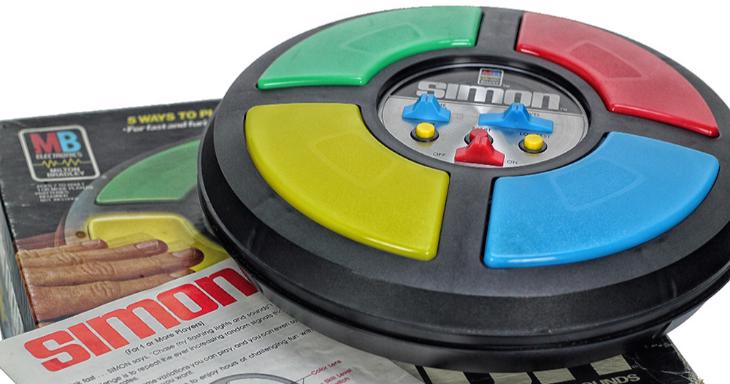
Classic Games & Toys Trivia Question
A classic electronic game question about Simon, colored lights, tones, and memory patterns.
Question

Which 1970s electronic memory game challenged players with lights and tones?

Correct Answer
Simon

The correct answer is Simon. Introduced in 1978, Simon challenged players to repeat growing sequences of colored lights and musical tones.

Like classic games and toys trivia?
Start a 10-question trivia challenge beginning with a question like this. No signup needed to begin.
Start the Challenge
Why Simon Is the Correct Answer

Simon is the 1970s electronic memory game that challenged players with lights and tones. The game was introduced in 1978 and became one of the best-known handheld electronic games of its era. It had a simple round design with four large colored buttons: red, blue, yellow, and green. Each button lit up and played its own musical tone. The player’s job was to watch and listen, then repeat the pattern exactly. Each successful round added another step, making the sequence longer and harder to remember.

Simon was created by Ralph H. Baer and Howard J. Morrison, working with toy designer Lenny Cope. Baer was already an important figure in electronic game history because of his role in developing the Magnavox Odyssey, the first commercial home video game console. Simon took a different path from screen-based video games. It was a self-contained tabletop or handheld electronic toy that used sound, light, and memory instead of a television display.

The name Simon came from the children’s game “Simon Says.” In the traditional game, players follow commands only when the phrase begins with “Simon says.” The electronic game used the same basic idea of copying instructions, but replaced spoken commands with patterns of lights and tones. The machine created a sequence, and the player had to repeat it. A mistake ended the turn. That made the game easy to understand in seconds, but difficult to master as the pattern grew longer.

Simon’s design was part of its success. The four-button circular layout was clean, bright, and immediately recognizable. The buttons were large enough for players of different ages to use, and the tones helped reinforce the memory challenge. Players were not only remembering colors. They were also remembering sounds, rhythm, and order. Someone might recall the sequence as “green, red, yellow,” while another player might remember it by the rising and falling notes. That mix of visual and audio memory gave the game a distinctive feel.

The game was introduced during a major shift in the toy industry. By the late 1970s, electronic toys were becoming more common, and families were beginning to see digital play as something new and exciting. Simon fit that moment perfectly. It did not require a cartridge, a screen, or complicated controls. It could sit on a coffee table, be passed around during family gatherings, or become a solo challenge. Its flashing lights also made it stand out in television commercials and store displays.

Simon was released by Milton Bradley, a company already known for classic board games. The game showed how traditional toy companies were adapting to electronics. It still felt like a family game, but it had the futuristic appeal of lights, tones, and programmed sequences. That combination helped Simon bridge the gap between old-fashioned tabletop games and the electronic entertainment boom that followed.

The challenge in Simon comes from working memory. The first few steps feel easy, but the difficulty rises quickly because every new round requires the player to repeat the entire sequence from the beginning. A long sequence demands concentration, pattern recognition, and calm timing. The game can become tense because one wrong button ruins the attempt. That pressure is part of what made it addictive. Players often wanted one more try to beat their previous score.

Simon became strongly associated with late 1970s and early 1980s pop culture. Its beeps, flashing colors, and space-age look made it feel modern at a time when electronic games were entering homes in a big way. It remained popular through later versions, travel editions, updated models, and digital adaptations. Even when newer games became more complex, Simon’s basic formula stayed effective because it was so clear and elegant.

More Classic Games & Toys Trivia Questions

Ready for another challenge?

Start a 10-question trivia challenge and see how many classic toys, board games, puzzles, and childhood favorites you know.

Start the Challenge