Classic Games & Toys Trivia Question
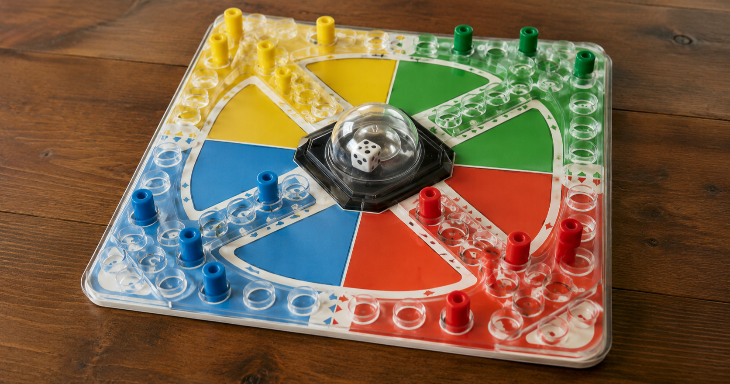
A classic board game question about Trouble and its Pop-O-Matic dice bubble.
Question

What classic board game uses a pop-up bubble to roll dice and was first released in the 1960s?

Correct Answer
Trouble

The correct answer is Trouble. First released in the 1960s, the game uses a Pop-O-Matic bubble in the center of the board to roll the die.

Like classic games and toys trivia?
Start a 10-question trivia challenge beginning with a question like this. No signup needed to begin.
Start the Challenge
Why Trouble Is the Correct Answer

Trouble is the classic board game that uses a pop-up bubble to roll dice and was first released in the 1960s. The game is best remembered for its Pop-O-Matic dice roller, a clear plastic dome in the center of the board. Players press the bubble, the die jumps inside, and the result appears without loose dice rolling across the table. That simple feature made Trouble instantly recognizable and helped it stand apart from many other race-style board games.

Trouble was introduced in the United States in 1965 by Kohner Brothers and later became strongly associated with Milton Bradley and Hasbro. The game’s basic goal is easy to understand: each player moves four colored pegs around the board and tries to get them safely home. Players start with their pieces outside the track, bring them onto the board, move around the path, and try to avoid being sent back to the beginning by an opponent’s piece.

The gameplay is similar in spirit to older cross-and-circle race games such as Pachisi, Parcheesi, and Sorry!, but Trouble’s identity comes from the Pop-O-Matic device. Instead of shaking dice in a hand or cup, the game turns the die roll into a small mechanical event. Pressing the dome creates a snap, bounce, and reveal. That sound and motion became one of the most memorable parts of the game. For many people, the phrase “pop the bubble” immediately brings Trouble to mind.

The Pop-O-Matic dice roller also had a practical benefit. It kept the die contained, which made the game easier for children to play. No one had to chase dice under the table, argue about whether a roll counted, or worry about pieces being knocked over by a wild toss. The die stayed sealed inside the board. That made the game neat, portable, and well suited for family rooms, kitchen tables, classrooms, and travel play.

In Trouble, rolling a six is especially important because it allows a player to move a peg out of the starting area and onto the track. Once pieces are in play, players race around the board while trying to land on spaces occupied by opponents. If a player lands on another player’s peg, that peg is sent back to start. This creates the game’s main tension. A player can be close to reaching home, then suddenly get knocked back and have to begin again. That mix of luck, simple strategy, and mild frustration is part of why the game has lasted so long.

The board’s bright colors and simple layout helped make Trouble appealing to younger players. Unlike games with long instructions or complex scoring, Trouble could be learned quickly. Children could understand the goal after watching only a few turns. At the same time, adults could play along without needing to simplify the rules much. That gave it the family-game quality that many 1960s and 1970s board games aimed for.

Trouble also fit the toy trends of the 1960s. Games with plastic parts, built-in mechanical features, and eye-catching packaging were becoming more common. The Pop-O-Matic bubble was a clever selling point because it was both functional and fun to demonstrate in commercials or store displays. It made the game feel more modern than traditional dice-and-board games, even though the movement rules were built on a very old style of race game.

Over the years, Trouble has appeared in many versions, including themed editions connected to popular characters and movies. Some versions added special spaces, cards, or rule changes, but the central feature remained the same. Without the Pop-O-Matic dome, Trouble would feel like a fairly standard race game. With it, the game has a distinctive sound, rhythm, and look that generations remember.

More Classic Games & Toys Trivia Questions

Ready for another challenge?

Start a 10-question trivia challenge and see how many classic toys, board games, puzzles, and childhood favorites you know.

Start the Challenge