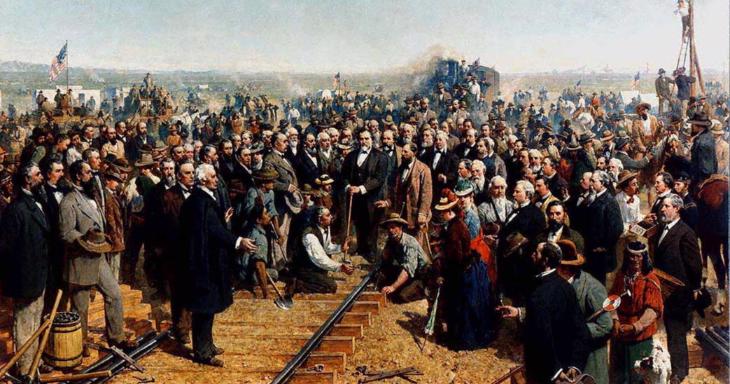
American History Trivia Question
A transportation history question about the railroad that connected America from east to west.
Question

Which rail line, completed in 1869, linked America’s east and west coasts?

Correct Answer
Transcontinental Railroad

The correct answer is the Transcontinental Railroad. Completed in 1869 at Promontory Summit in Utah Territory, it linked America’s eastern rail network with the Pacific Coast.

Like American history trivia?
Start a 10-question trivia challenge beginning with a question like this. No signup needed to begin.
Start the Challenge
Why the Transcontinental Railroad Is the Correct Answer

The First Transcontinental Railroad was the rail line completed in 1869 that linked America’s east and west coasts. It connected the existing eastern rail network with the Pacific Coast, making cross-country travel faster, safer, and more practical than it had ever been before. The line was completed on May 10, 1869, at Promontory Summit in Utah Territory, where the Central Pacific and Union Pacific railroads met in a ceremony remembered for the driving of the Golden Spike.

Before the transcontinental railroad, travel across the continent was slow and difficult. People heading west often went by wagon train, stagecoach, or ship. Wagon travel could take months and involved harsh weather, rough terrain, disease, and danger. A sea journey from the East Coast to California could mean sailing around South America or crossing the Isthmus of Panama before continuing by ship. The railroad changed that dramatically. A trip that once took months could be made in about a week.

The project was built mainly by two companies. The Union Pacific Railroad built westward from Omaha, Nebraska, across the Great Plains and toward the Rocky Mountains. The Central Pacific Railroad built eastward from Sacramento, California, through the Sierra Nevada and across Nevada. The two lines met in Utah, creating the first continuous rail route between the eastern United States and the Pacific Coast. This did not mean one single company owned the whole route. It meant that connected tracks now allowed passengers and freight to move across the continent by rail.

The construction was one of the largest engineering achievements in 19th-century America. Workers faced mountains, deserts, rivers, snow, heat, and isolation. The Central Pacific’s work through the Sierra Nevada was especially difficult. Crews had to blast tunnels through granite, build snow sheds, and work in dangerous winter conditions. Many of the Central Pacific workers were Chinese immigrants, whose labor was essential to the project. They performed some of the hardest and most dangerous work, often for lower pay than white workers and under harsh conditions.

The Union Pacific relied heavily on Irish immigrants, Civil War veterans, formerly enslaved workers, and other laborers as it built across the plains. Its crews faced supply problems, conflict, weather, and the pressure to lay track quickly. Both companies were given federal support through land grants and government bonds under the Pacific Railway Acts. The race to lay more track was partly driven by profit, since each company received benefits based on how much line it built.

The completion ceremony at Promontory Summit became one of the best-known moments in American transportation history. Representatives of the two railroads gathered as the final ceremonial spike was driven. The famous Golden Spike was not an ordinary working spike, but a symbolic one. The event was photographed, and the image of the locomotives facing each other became an enduring symbol of national connection. The phrase “East and West” meeting at Promontory became tied to the idea of a country physically joined by rail.

The railroad had enormous effects on the United States. It helped move settlers west, carried farm goods and manufactured products, supported mining and ranching, and expanded trade with the Pacific. Towns grew along the route, and markets became more connected. Mail, newspapers, people, and goods could move with new speed. The railroad also helped standardize time, since train schedules required more consistent timekeeping across regions.

Its impact was not only positive. The transcontinental railroad accelerated westward expansion onto Native lands and increased conflict with Indigenous nations. The building of rail lines, the movement of settlers, and the growth of buffalo hunting disrupted Plains tribes and their way of life. The railroad is often remembered as a triumph of engineering and national ambition, but it was also part of a larger history of displacement, land seizure, and environmental change.

The correct answer is the First Transcontinental Railroad. Completed in 1869, it linked America’s rail systems from east to west and transformed travel, trade, settlement, and the future of the American West.

More American History Trivia Questions

Ready for another challenge?

Start a 10-question trivia challenge and see how many famous events, documents, presidents, and historic moments you know.

Start the Challenge