Classic Games & Toys Trivia Question
A nostalgic toy history question about View-Master, 3D images, and circular picture reels.
Question

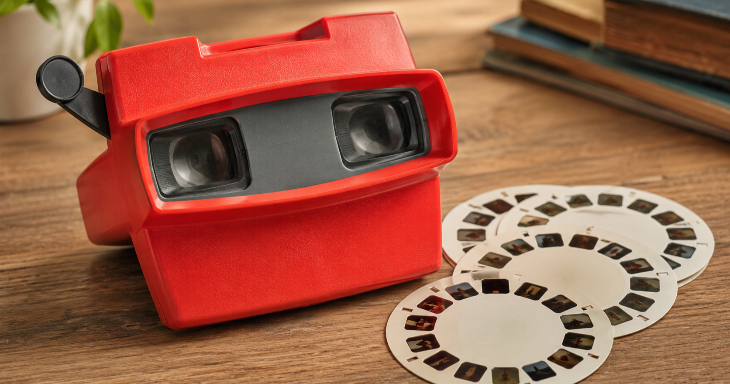
Which toy, first introduced in 1939 and later popular with kids in the 1960s, allowed users to view 3D images using circular picture reels?

Correct Answer
View-Master

The correct answer is View-Master. First introduced in 1939, it used circular picture reels and a handheld viewer to let users see 3D images.

Like classic games and toys trivia?
Start a 10-question trivia challenge beginning with a question like this. No signup needed to begin.
Start the Challenge
Why View-Master Is the Correct Answer

View-Master is the toy first introduced in 1939 that later became popular with children in the 1960s, allowing users to view 3D images through circular picture reels. It became one of the most memorable visual toys of the 20th century because it combined photography, travel, entertainment, and novelty in a simple handheld device. A person inserted a round reel into the viewer, held it up to a light source, and looked through the eyepieces to see a sequence of small color images with a three-dimensional effect.

The View-Master was introduced at the 1939 New York World’s Fair. It was developed by William Gruber, who was interested in stereoscopic photography, and Harold Graves of Sawyer’s, a company based in Oregon. The idea behind the device was to make stereoscopic viewing easy for the public. Stereoscopic images work by showing each eye a slightly different picture. When the brain combines the two images, the result appears to have depth. That is what gave View-Master its famous 3D look.

In its earliest years, View-Master was not thought of mainly as a children’s toy. It was first sold more as a viewer for scenic photography and travel images. Early reels showed national parks, cities, landmarks, and tourist attractions. At a time when many people could not easily travel long distances, View-Master gave them a way to see colorful scenes from around the United States and other parts of the world. It was educational, entertaining, and visually impressive.

The circular reels were one of the most distinctive parts of the product. Each reel held seven pairs of tiny color transparencies. As the user pressed the lever on the side of the viewer, the reel advanced to the next image. That click-and-view rhythm became part of the experience. Many people remember sitting by a lamp or a sunny window, clicking through scenes one by one and feeling as if they were looking into a miniature world.

By the 1950s and especially the 1960s, View-Master became much more closely associated with children. The company expanded beyond travel scenes and began producing reels based on cartoons, fairy tales, television programs, movies, and educational subjects. That shift helped make the toy a common gift for birthdays and holidays. Children could use it for entertainment, but it also had a learning side, which made it appealing to parents.

Part of the charm of View-Master was that it felt personal. Unlike television, which everyone in the room watched together, the View-Master was a one-person experience. A child held it up to their own eyes and explored the images privately. That gave it a sense of discovery. The pictures also seemed more vivid because of the 3D effect. Even a simple scene could feel more alive than a flat printed photograph.

The design of the viewer changed over the years. Early models had a more formal look, while later ones became more colorful and toy-like, especially the familiar red plastic version many people remember. Even so, the basic idea stayed the same. Insert the reel, look through the eyepieces, click the lever, and move from image to image. That simple format is one reason the toy lasted so long.

View-Master also reflected larger changes in American culture. It grew during a period when photography, tourism, and family entertainment were all becoming more important. It later adapted to the growing influence of television and licensed characters. In that way, the toy managed to bridge several worlds. It could be educational, nostalgic, collectible, and playful all at once.

The answer is View-Master. Its 1939 debut, circular picture reels, and memorable 3D viewing experience made it one of the most recognizable classic toys of the mid-20th century.

More Classic Games & Toys Trivia Questions

Ready for another challenge?

Start a 10-question trivia challenge and see how many classic toys, board games, puzzles, and childhood favorites you know.

Start the Challenge