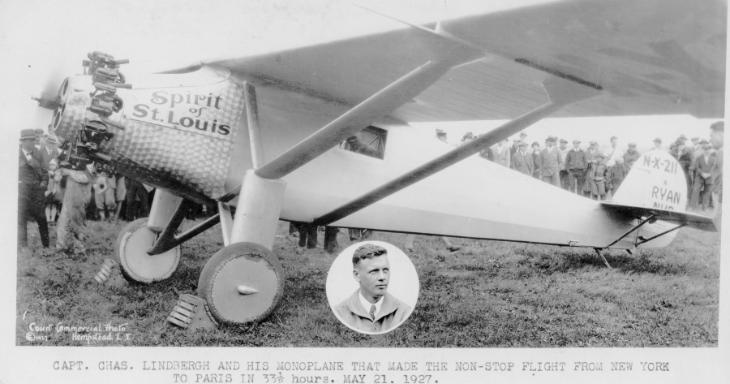
The correct answer is Charles Lindbergh. On May 20, 1927, he took off from Roosevelt Field in New York in the Spirit of St. Louis and completed the first solo nonstop flight across the Atlantic.
Charles Lindbergh was the American pilot who took off from New York on May 20, 1927, on the first solo nonstop flight across the Atlantic Ocean. He flew a custom-built single-engine airplane called the Spirit of St. Louis from Roosevelt Field on Long Island, New York, to Le Bourget Field near Paris, France. The flight made Lindbergh an international celebrity and became one of the defining aviation achievements of the 20th century.
Lindbergh was only 25 years old when he made the flight. Before that, he had worked as a barnstormer, stunt pilot, flight instructor, and U.S. Air Mail pilot. That mail-flying experience mattered because it taught him how to navigate, handle bad weather, and stay calm during long, dangerous flights. In the 1920s, aviation was still young, risky, and physically demanding. Airplanes were far less reliable than modern aircraft, and long-distance navigation over open ocean was extremely difficult.
The flight was connected to the Orteig Prize, a $25,000 award offered to the first aviator who could fly nonstop between New York and Paris. Several well-known pilots had tried or prepared to try, and some had died in the attempt. Lindbergh was not the most famous candidate, and his plan seemed risky because he chose to fly alone in a single-engine plane. The decision reduced weight but left him with no backup pilot if he became exhausted or encountered trouble.
The Spirit of St. Louis was built by Ryan Airlines in San Diego. Lindbergh helped design it with one purpose in mind: maximum range. The plane carried a large amount of fuel, and to make room for the forward fuel tank, Lindbergh did not have a front windshield. He looked out the side windows and used a small periscope when needed. That unusual design improved fuel capacity but made flying more difficult. Comfort was sacrificed almost completely. The cockpit was cramped, and Lindbergh had to remain awake and alert for the entire journey.
He took off from Roosevelt Field on the morning of May 20, 1927. The aircraft was heavy with fuel and struggled to lift off, clearing obstacles at the edge of the field with little margin. From there, Lindbergh flew northeast along the coast, passed over Newfoundland, crossed the Atlantic, reached Ireland, then continued across England and France. He faced fog, icing, darkness, fatigue, and the constant risk of navigation error. At times, he flew low over the ocean to stay oriented and avoid dangerous conditions.
The flight lasted about 33 and a half hours. When Lindbergh reached Paris on May 21, 1927, a huge crowd was waiting at Le Bourget Field. The crowd was so large and excited that it surrounded the plane almost immediately after landing. Lindbergh had left New York as a daring but relatively unknown pilot. He landed in France as a worldwide hero.
The achievement changed public attitudes toward aviation. Lindbergh’s solo nonstop transatlantic flight showed that long-distance air travel could become practical, not just experimental. Airlines, aircraft manufacturers, and aviation investors gained attention after his success. People who had viewed airplanes as dangerous novelties began to imagine a future in which air travel connected continents.
Lindbergh was nicknamed “Lucky Lindy” and became one of the most photographed and celebrated figures of his era. He received honors in Europe and the United States, including the Medal of Honor. His book about the flight, We, became a bestseller, and the Spirit of St. Louis was later placed in the Smithsonian’s collection, where it remains one of the most famous aircraft in American history.
The correct answer is Charles Lindbergh. His May 20, 1927, takeoff from New York and successful landing near Paris the next day made the Spirit of St. Louis flight one of the most important milestones in aviation history.
Start a 10-question trivia challenge and see how many famous events, documents, presidents, and historic moments you know.
Start the Challenge