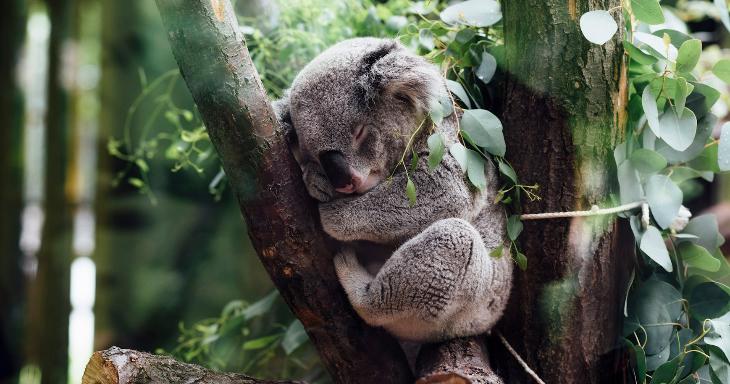
The correct answer is koala. Koalas have fingerprints with friction ridge patterns so similar to humans that they can look surprisingly human-like under close inspection.
Koala is the Australian animal with fingerprints so similar to humans that they can confuse crime scene investigators. Koalas are marsupials native to Australia, and while they are best known for climbing eucalyptus trees and sleeping for long hours, their hands have a surprising feature: koala fingerprints can look remarkably close to human fingerprints under close inspection.
Fingerprints are made from raised patterns on the skin called friction ridges. In humans, these ridges form loops, whorls, and arches that help create unique prints on the fingertips. Koalas also have friction ridges on their fingers, and the patterns can be so detailed and human-like that even experts may need careful analysis to tell them apart. That is why koalas are often mentioned in connection with the unusual idea that an Australian animal could leave fingerprints similar to humans.
The comparison is striking because koalas are not closely related to humans. Humans are primates, while koalas are marsupials, a group of mammals whose young are born at an early stage of development and continue growing in a pouch. Other marsupials include kangaroos, wallabies, wombats, and possums. Koalas belong to a very different branch of the mammal family tree, yet they developed fingerprint-like ridges that resemble those found in people. This is an example of similar features evolving in unrelated animals because they serve a useful purpose.
The likely reason for koala fingerprints has to do with touch and grip. Koalas spend much of their lives in trees, especially eucalyptus trees. They climb, hold branches, grasp leaves, and move through uneven surfaces high above the ground. Friction ridges may help their fingers grip eucalyptus branches more securely. The ridges can also improve sensitivity, helping the animal feel textures and handle leaves more precisely. For an animal that depends on climbing and feeding in trees, better grip and touch can be a real advantage.
Koala hands are well suited for life in the trees. Their front paws have two opposable digits, which help them grasp branches firmly. Their claws are strong and curved, giving them extra support as they climb. Fingerprints add another layer of control by increasing contact between the skin and the surface being held. This combination of claws, gripping fingers, and friction ridges helps koalas move through their eucalyptus habitat.
The idea that koala fingerprints could confuse crime scene investigators has become one of the most memorable facts about the animal. In real forensic work, investigators look closely at ridge patterns, print placement, size, pressure, and other evidence. A koala is not likely to be a serious suspect, of course, but the similarity is still remarkable. If a koala left a clear print on a suitable surface, the pattern could appear surprisingly human-like at first glance.
This feature also makes koalas unusual among non-primate animals. Fingerprints are most famously associated with humans and other primates, such as chimpanzees and gorillas. Koalas stand out because they evolved similar skin patterns despite being marsupials. That makes their fingerprints especially interesting to scientists studying evolution, anatomy, and how animals adapt to their environments.
Koalas are closely tied to Australia’s eucalyptus forests. They feed mostly on eucalyptus leaves, which are tough, fibrous, and low in nutrition. Because their diet provides limited energy, koalas spend much of the day resting or sleeping. Their bodies are adapted to this specialized lifestyle, from their digestive system to their climbing limbs. Their fingerprint-like ridges are one more detail showing how specifically adapted they are to life in trees.
The answer is koala. This Australian marsupial has fingerprints similar to humans because of detailed friction ridges on its fingers, likely useful for gripping eucalyptus branches and handling leaves. That human-like pattern is so close in appearance that it has become one of the most surprising facts about koalas and one of the strangest connections between wildlife and forensic science.
Start a 10-question trivia challenge and see how many wildlife, birds, insects, plants, oceans, forests, and natural wonders you know.
Start the Challenge