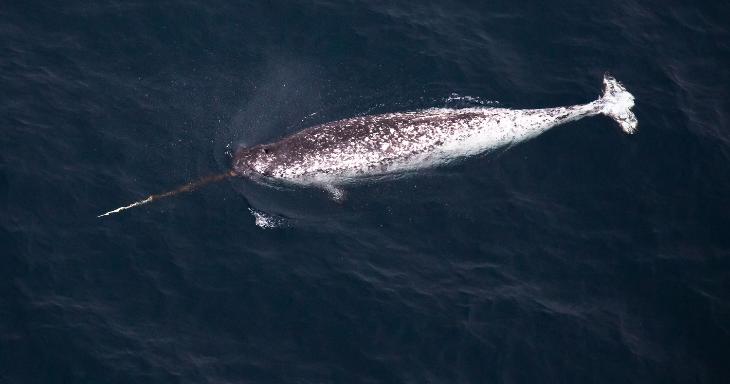
The correct answer is narwhal. This Arctic toothed whale is nicknamed the Unicorn of the Sea because of its long spiral tusk, which is actually an enlarged tooth.
Narwhal is the marine mammal found primarily in Arctic waters that has the nickname “Unicorn of the Sea.” The nickname comes from the animal’s long, straight, spiral tusk, which can look almost mythical when seen extending from the front of its head. Narwhals are real Arctic whales, but their unusual appearance has made them one of the most distinctive animals in the cold northern oceans.
A narwhal is a toothed whale, related to belugas, dolphins, porpoises, sperm whales, and orcas. Unlike baleen whales, which filter tiny prey from seawater, toothed whales have teeth and usually hunt fish, squid, and other animals. Narwhals are medium-sized whales with rounded heads, mottled gray skin, and no tall dorsal fin. That lack of a prominent dorsal fin may help them move under sea ice, where a tall fin could be a disadvantage.
The famous spiral tusk is not a horn. It is actually an enlarged tooth, most often the left canine tooth, that grows outward through the upper lip. It can reach several feet in length and has a twisted, helical shape. The tusk is usually seen in males, though some females can grow one too. Rare narwhals may even have two tusks. Because the tusk projects forward like a unicorn’s horn, the narwhal became widely known as the Unicorn of the Sea.
For centuries, narwhal tusks helped feed legends about unicorns. In medieval and Renaissance Europe, tusks were sometimes traded as “unicorn horns” and treated as rare, valuable objects. People believed they had magical or medicinal powers. The real source was the narwhal, an Arctic marine mammal most Europeans had never seen alive. That history helped strengthen the animal’s mysterious reputation long before modern science explained what the tusk actually was.
Scientists have studied the narwhal tusk for years because it is more complex than it first appears. It contains nerve endings and may help the animal sense changes in its environment, such as water temperature, salinity, or pressure. Males may also use tusks in social displays, dominance behavior, or interactions with other males. Narwhals have been seen crossing tusks in a behavior sometimes called tusking. The exact purpose of the tusk is still studied, but it is clearly more than a simple decoration.
Narwhals live in the Arctic Ocean and nearby northern waters, especially around Canada, Greenland, Norway’s Svalbard region, and parts of Russia. They are strongly associated with cold northern waters because their lives are tied to sea ice. During the summer, they may spend time in coastal bays and fjords. In winter, many move offshore into deeper waters where they live among shifting ice and use cracks or openings to breathe.
Their Arctic habitat makes narwhals difficult to study. They spend much of their time in remote areas, often under ice and far from large human settlements. They can dive deeply in search of food, feeding on fish such as Greenland halibut, along with squid, shrimp, and other prey. Like other whales, narwhals must surface to breathe air, so access to openings in the ice is essential for survival.
Narwhals are also part of the cultural and subsistence traditions of Inuit communities in the Arctic. For northern peoples, narwhals have long provided food and materials, and knowledge of their movements is tied to local experience with sea ice, seasons, and marine life. The animal’s importance is not only biological, but also cultural.
The narwhal’s future is closely connected to the changing Arctic. Because it depends on sea ice and cold-water ecosystems, shifts in ice cover, shipping routes, noise, and climate conditions can affect its habitat. Narwhals are adapted to a very specific environment, which makes changes in the Arctic especially important for their survival.
The answer is narwhal. This Arctic toothed whale earned the nickname Unicorn of the Sea because of its long spiral tusk, an enlarged tooth that gives the animal one of the most unusual appearances of any marine mammal.
Start a 10-question trivia challenge and see how many wildlife, birds, insects, plants, oceans, forests, and natural wonders you know.
Start the Challenge